Hummingbirdasaurus

Being retired, I’m sitting here looking out the front window getting weirded out by hummingbirds. Look at ‘em, hovering around the feeder, fighting, stabbing each other—they do, they’re vicious little fuckers around the feeder—and screaming at each other in high pitched strings of hummingbird threats and hysteria. But they’re so cute, you say. Which they are, even I have to give them that. If they were huge they’d be terrifying, but they’re not, they’re dinky, the smallest living dinosaur. And it’s weird to think, if you’re the sort who thinks like this, that they are closer to sauropods than they are to us. That’s right, hummingbirds are more closely related to these huge guys
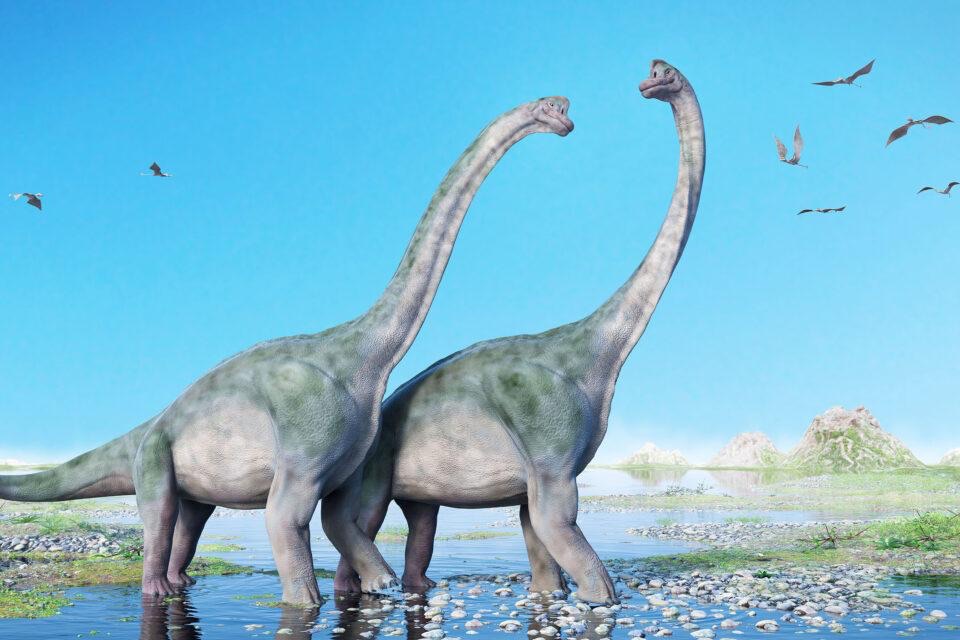
Brachiosaurs, I think. Big sauropods, anyway.

than they are to us. It’s not that they’re descended from huge sauropods—that would have been some spectacular evolution—but that hummingbird evolution goes back through birds to the last common dinosaur ancestor from which what became sauropods and what became theropods (ranging from tyrannosaurs to the protobird archaeopteryx) which is still a long way from the last common ancestor that we share with dinosaurs. Thus a hummingbird is much closer to those enormous lumbering quadruped brontosauruses than it is to us. And while Deep Time has done some weird shit (us, for instance), you’d be hard pressed to find anything more ridiculous than traces of a mutual ancestor 230,000,000 years or so ago in the skeletons of that tiny hummingbird out there and these whatchamallitosauruses pictured here.

Admittedly, an even closer mutual ancestor can be seen in the skeletons of us and the dimetrodon
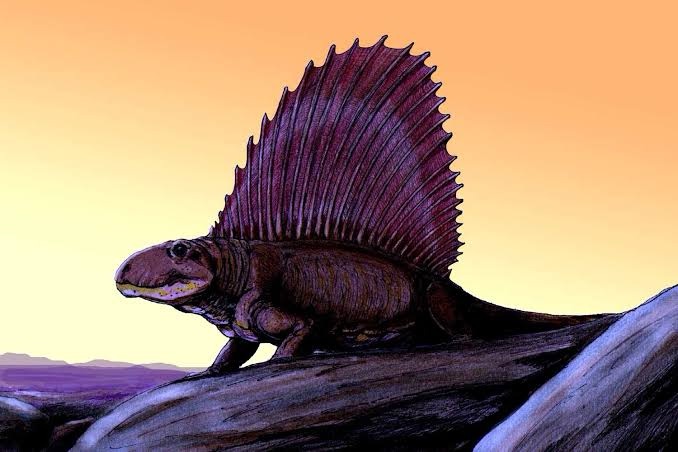
A Dimetrodon basking in the last light of a Permian day.

though we didn’t get that groovy sail (which would’ve evolved after the evolutionary paths of the dimetrodon and mammals parted ways), but we both came from the same mutual ancestor way back in the Permian Age, when critters like the dimetrodon (mostly unsailed) were the biggest critters on dry earth, and judging from the number of fossils dug up were as common (if bigger) then as lizards are now. Nearly all were zapped into extinction in the cataclysm at the end of the Permian, though somehow whatever eventually became you, me, your kitty and Baluchitheriums survived.
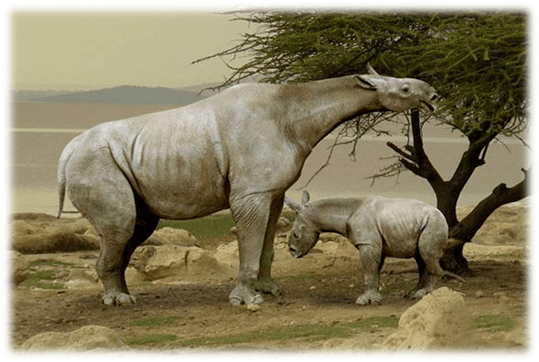
A ridiculously huge Baluchitherium.

That’s our connection with the Dimetrodon, at some time deep in the Permian Age what became a dimetrodon and what became mammals were the same critter. Synapsids—you, me, the dimetrodon, but not dinosaurs, we’re all synapsids. (They used to call synapsids the much easier to say mammal-like reptiles.) Those aggro little hummingbirds out there are dinosaurs (really, birds are as dinosaur as we are mammal), which we shared a very distant ancestor with before synapsids even evolved, going way back into the Permian. Back when big amphibians ruled the roost, proto-newts, big scary slimy things the size of Nile crocodiles. Thats how far you gotta go back to see when you and me and those hummingbirds were all tucked into the same genome. So hummers are as much more akin to giant sauropods than to anything remotely like us. Which makes us and that dimetrodon more similar than you’d expect.

And while nowhere near as big as we imagined it when it tumbled out of our package of plastic dinosaurs on Christmas morning (this was a while ago)—I am taller than it was, sail and all—a dimetrodon is still incredibly weird looking. I mean what’s with the sail? Cooling? Warming? Mating? Male gnarliness? In comparison, as tall as I am (six foot five, nearly two meters) I couldn’t even reach the knee of that giant sauropod standing on my tip toes. It’d squish me into the mud on its way to a giant fern tree. I look at all those goddam hummingbirds swarming around the feeder and I think that. The retired life. Now time for my nap.
Qaxal

(Commenting on Facebook about a photo of a California quail.)

One of my favorite desert birds! And agreed on Qaxal, which looks so lovely spelled out. Alas, it’s probably just about impossible to pronounce for we English speakers, or for just about any speaker of an Indo-European language. From the sounds alone you can feel the thousands of generations that separate the development of the sounds our mouths use to speak English from the sounds a táxliswet (the Chemenuevi word for a Cahuilla person, per Wikipedia) uses to speak the Cahuilla language. Hell, we call the language Cahuilla because we can’t possibly say ʔívil̃uʔat. We call the the tribe Cahuilla because we can’t possibly say ʔívil̃uqaletem. The Spanish called them Cahuilla because the ʔívil̃uʔat word for master sounded something like “cahuilla” to a Spaniard’s ear. That’s right, for master. Amazing the history in a word.

And while we’re not on the subject, though geographically neighbors, the languages the Chemehuevi and Cahuilla spoke are about as far apart from one another as English is from Hindustani. That is both are part of the same language family (as are English and Hindustani) but each gone it’s own way for many thousands of years since they were the same language. Alas, Chemehuevi (which i seem to remember is actually a Mojave word spelled out in Spanish, I don’t know what their own word for their own language was) is now extinct with no living speakers who learned it as children. It survives in academic circles mostly, or in how to pronounce apps (like the one I heard that pronounces “Chemeheuvi” in a beautifully lilting Castilian accent, Spanish music strumming in the background.) Cahuilla is still spoken by a few dozen native speakers but is unlikely to survive them. It’d be nice if either qaxal or kakara, even mispronounced, survived as a name for these desert birds. Neither is likely to. Words from tiny languages tend to disappear with their speakers.

But I digress.

Great post.

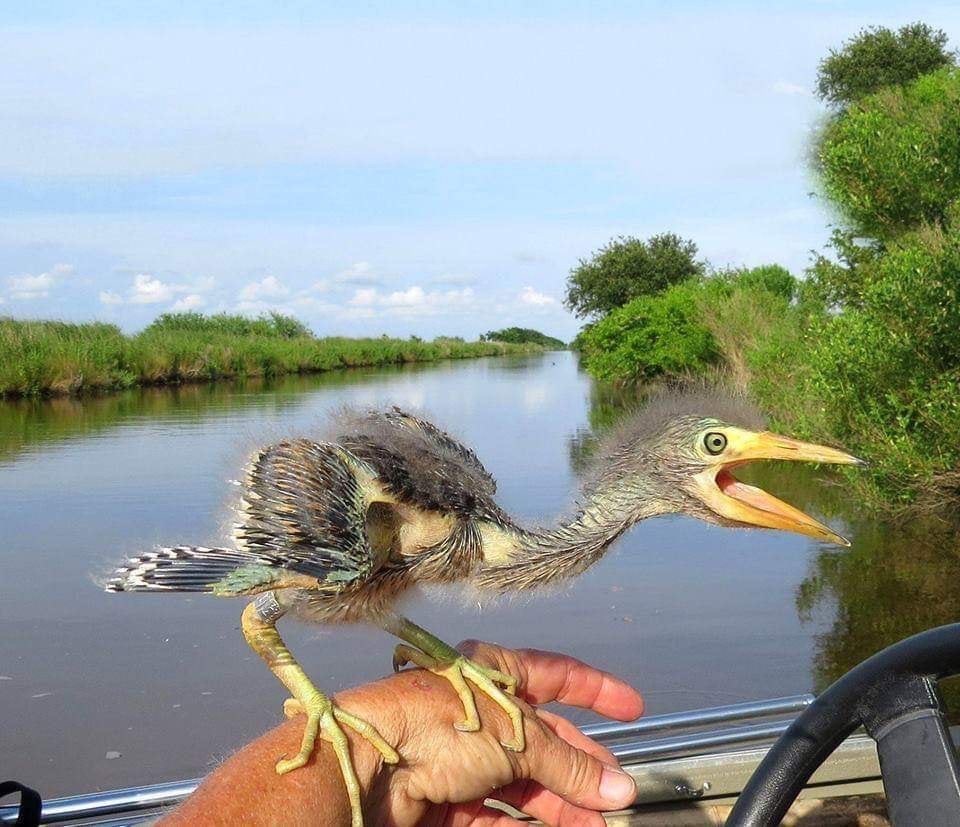
Greenheronsaurus

Pretty damn close. This baby green heron doesn’t have any teeth, which a dinosaur would have. And a heron’s wings are much, much stronger than any of its ancestors would have had in the dinosaur era. Feathers, too, have undergone sixty five million years of continuous evolution since the dinosaurs. But for us laypeople (layhumans?) it’s awfully difficult to look at this guy and see the differences between it and a dinosaur sixty-five or a hundred million years ago. It’s a good thing for Stephen Spielberg that Chinese paleontologists uncovered the mother lode of feathered dinosaurs in China after the Jurassic Park series had begun. Well, they’d already been digging them up, it just took a while for the realization to sink in with the public, who were having problems enough trying to accept that an asteroid had ended the Age of the Dinosaurs in a flash. Those were the days when if you knew that tyrannosauruses had feathers you kept it to yourself. You didn’t blurt that kind of thing out, and you certainly didn’t say in it front of the kids. You see that Tyrannosaurus rex chasing Laura Dern? The one that nearly chomped down Jeff Goldblum? It looked like a huge, psychotic chicken! The ushers would deposit your ass out on the curb before you could say Zhuchengtyrannus magnus.

A baby green heron. Photo by JJJ Frank (from the Fascinating page on Twitter)

Cats, Coyotes and the Sixth Mass Extinction

This could seriously use a rewrite but I’ll post it as is for now . . . . When coyotes wiped out all the cats outdoors—strays and pets let outside alike—the number of bird species we’d see about tripled. You could even hear it in the variety of songs, even the motherfuckers with the vocal range of a smoke alarm who start their incessant idiot one note song about dawn. Anyway, the now long endemic local coyote population was a sad thing for the cats, but great for the local bird population. The rat and mouse population exploded without all the cats, but that brought in the owls (two or three different species) who were more effective at rodent extermination than the cats. Without the rodents and stray cat kittens, though, the hawk population has dropped, and they no longer land on our railing and stare into our living room, wondering if we have any small animals or babies in there.

I love cats, though. We’ve had I don’t know how many. But I can’t help seeing them as the perfect hunting machines that they are, as perfectly evolved as sharks are for hunting, and, like sharks, they’ve varied little over their millions of years from their fundamental design. There might not be any other mammal as perfectly designed for hunting as are cats. And they do it so easily. They can kill a dozen birds a night and have no idea the whole point was to eat the thing. Alas for housecats, the social structure and improvisational hunting skills of the coyote means housecats are easy meat, and coyotes don’t waste time playing with their catch, they eat them. But make a cat bigger than a coyote and it’s no contest. Coyotes don’t eat cougars, but are a regular feature on a cougar’s palate. Revenge. The natural world is kind of fucked and heartless when you think about it.

Cats are one of the drivers of the sixth mass extinction. Not the undomesticated species of wildcats, but felis catus, the house cat. We multiplied the population of one of the world’s most effective small hunters by hundreds of millions (worldwide there are over 200 million pet cats and about a half billion strays), and dropped them in places where often native cats never existed and they’ve decimated bird, small mammal and reptile populations often to the point of extinction. It’s not an even fight, and coyotes here in Southern California are about the only sure fire way to limit bird predation. Where coyotes go, bird populations follow. Cats, like rats, come with people and where they go species loss follows. Every time you see a new residential neighborhood in an undeveloped spot you have to figure that most of native birds in the area will be wiped out by cats in very short order. Sadly, the vast majority of birds killed by cats are never eaten. Eating a bird is a learned housecat behavior, hunting is a built in skill. So coyotes are just sort of resetting the balance, wiping out introduced predators and letting the bird populations recover. A very rare reversal of the Sixth Mass Extinction.

La Brea tar pits

We’re so used to the La Brea Tar Pits in Los Angeles we don’t even realize just how incredibly cool and bizarre it is that such a place is right there on the Miracle Mile. One of my favorite places and museums. Saw a pigeon trapped in one of the little pools of tar there once. A thin veneer of water laid on top of the tar, and the pigeon had just walked on in as a pigeon will. It sat there, doomed, illustrating how the thing worked. That was at least twenty years ago, and it’s bones were long ago sucked down into the tar and eventually, in an instant of geologic time, will fossilize into a beautifully preserved skeleton of a pigeon. Still, I felt really sorry for the little thing.

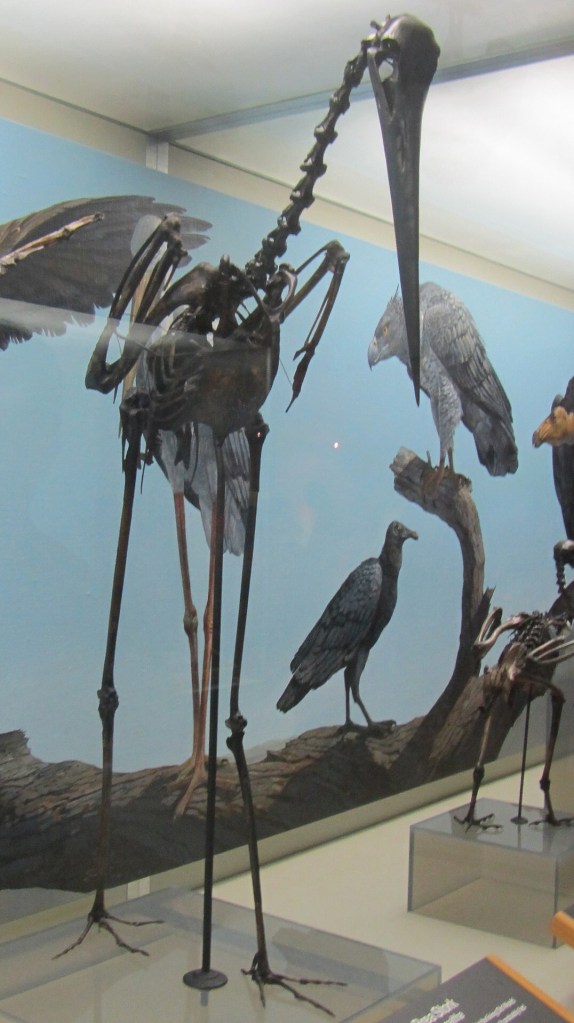
Ciconia maltha from the La Brea Pits. Not a pigeon.

Crows

This is wild. Crows in this study could tell that recordings of people speaking Japanese (the language of the researchers) was different from recordings of people speaking Dutch. We can’t do that listening to birds. Unless we were a highly trained specialist, we couldn’t distinguish between mockingbird songs in one part of the country from mockingbird songs in another part of the country, though each song has a ‘dialect” that makes them mutually unintelligible. All the mockingbird would know is that another mockingbird is yelling at it. It has to learn to sing in the local dialect (meaning mockingbirds have learned cultures, actually.) But when a crow hears recordings of humans speaking different languages, it can tell that we are not speaking the same language, and it reacts to them differently. They were used to Japanese. They were wary of the recording in Dutch. What were they hearing? Japanese isn’t tonal like Chinese, so it’s not that the crows can tell that one is melodic and the other not. Can they detect the different phonemes (the vowel and consonant sounds) the languages use? Can they distinguish stresses, like what part of a sentence rises or drops? Can they detect the specific rhythms or sound patterns of grammar? How is it that a goddam bird can tell if a person is speaking Dutch or speaking Japanese while we with our enormous brains can’t tell if a recording of a mockingbird screaming at five in the morning is in Southern California Mockingbirdese or Danish Mockingbirdese? I can write about the concept of a crow distinguishing human languages, but damn if I can imagine what it is they actually hear in our human sounds.

Mockingbirds

Listening to these mockingbirds improv reminds me of a factoid I read today in Daniel Tammet’s Embracing the Wide Sky that in order for male songbirds to sing some of the incredibly complex songs which change constantly, up to one per cent of the neurons in their song center are replaced by new neurons every single day, which adds up pretty quickly. That’s what those mockingbird brains are doing, rebuilding themselves continuously. Not adding brain cells to what is there already, but replacing them. It’s as if in order to speak we had to replace 100% of the neurons in our language center every 100 days. (Well, replacing one percent every day is not the same as replacing 100% every hundred days but what the hell, let me run with it.) That is, all the grammar we’ve hardwired into our brain is replaced by entirely new brain cells with all new intricately laced connections between them four times a year. OK, it’s not quite that simple (some of the neurons in the mockingbird’s song center will be replaced more often than others and others are more permanent), but still, our grammar and vocabulary would completely and fundamentally change over a period of a hundred days. Not all at once, but a little everyday so that you’d be speaking a completely different language in April from what you were speaking on January 1. I’m writing this in English now and a hundred days from now I’d be writing this in Armenian, and next year in Sioux. Plus I’d wake you up at five in the morning screaming outside your window.

Owls

I could hear a pair of great horned owls calling to each other just now, first the female’s somewhat higher pitch, sort of like that of a mourning dove. Then the male’s deeper, louder response. They alternated like that for several minutes. Each call was three notes in a monotone, breathy and eerie, and by day would be buried under the cacophony of mockingbirds, but in the weird silence of our neighborhood tonight, like a country town just a couple miles from Hollywood and downtown, I could hear them plainly even though the windows are shut. I snuck outside to see if I could glimpse a silhouette, but nothing, just the haunting notes back and forth. Soon only the female called, the male having stolen away in silence. Then she too stopped, and there was almost complete silence but for the steady hum of traffic on the freeway in the distance.