Hummingbirdasaurus

Being retired, I’m sitting here looking out the front window getting weirded out by hummingbirds. Look at ‘em, hovering around the feeder, fighting, stabbing each other—they do, they’re vicious little fuckers around the feeder—and screaming at each other in high pitched strings of hummingbird threats and hysteria. But they’re so cute, you say. Which they are, even I have to give them that. If they were huge they’d be terrifying, but they’re not, they’re dinky, the smallest living dinosaur. And it’s weird to think, if you’re the sort who thinks like this, that they are closer to sauropods than they are to us. That’s right, hummingbirds are more closely related to these huge guys
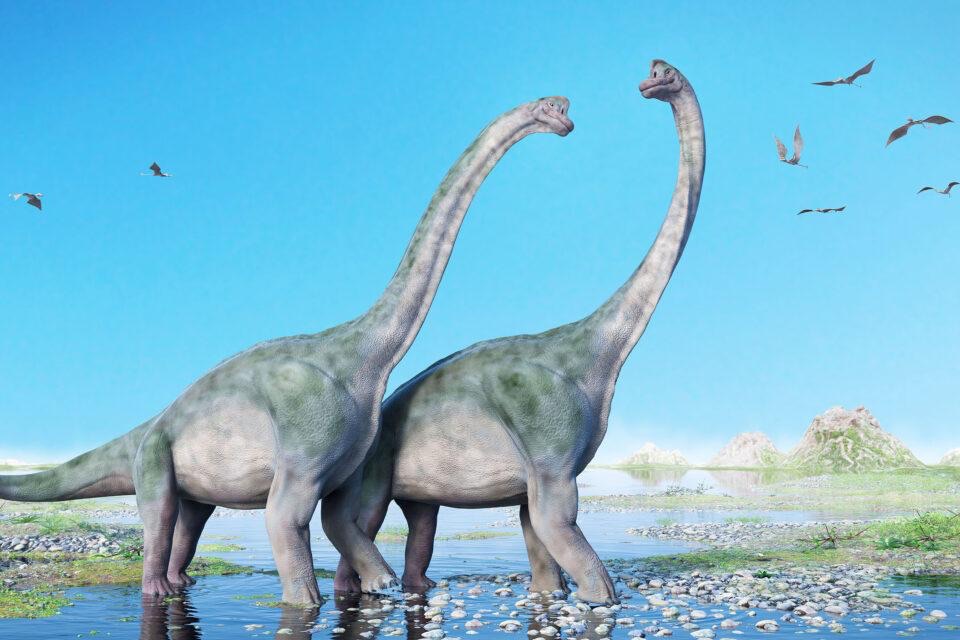
Brachiosaurs, I think. Big sauropods, anyway.

than they are to us. It’s not that they’re descended from huge sauropods—that would have been some spectacular evolution—but that hummingbird evolution goes back through birds to the last common dinosaur ancestor from which what became sauropods and what became theropods (ranging from tyrannosaurs to the protobird archaeopteryx) which is still a long way from the last common ancestor that we share with dinosaurs. Thus a hummingbird is much closer to those enormous lumbering quadruped brontosauruses than it is to us. And while Deep Time has done some weird shit (us, for instance), you’d be hard pressed to find anything more ridiculous than traces of a mutual ancestor 230,000,000 years or so ago in the skeletons of that tiny hummingbird out there and these whatchamallitosauruses pictured here.

Admittedly, an even closer mutual ancestor can be seen in the skeletons of us and the dimetrodon
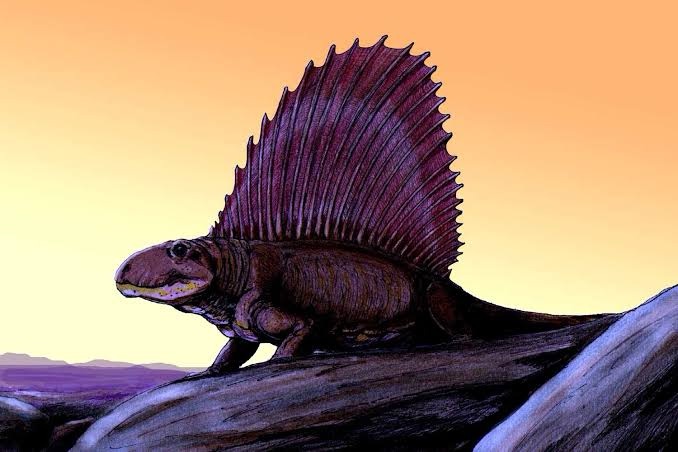
A Dimetrodon basking in the last light of a Permian day.

though we didn’t get that groovy sail (which would’ve evolved after the evolutionary paths of the dimetrodon and mammals parted ways), but we both came from the same mutual ancestor way back in the Permian Age, when critters like the dimetrodon (mostly unsailed) were the biggest critters on dry earth, and judging from the number of fossils dug up were as common (if bigger) then as lizards are now. Nearly all were zapped into extinction in the cataclysm at the end of the Permian, though somehow whatever eventually became you, me, your kitty and Baluchitheriums survived.
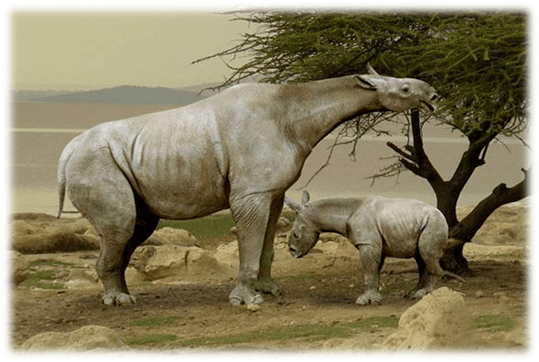
A ridiculously huge Baluchitherium.

That’s our connection with the Dimetrodon, at some time deep in the Permian Age what became a dimetrodon and what became mammals were the same critter. Synapsids—you, me, the dimetrodon, but not dinosaurs, we’re all synapsids. (They used to call synapsids the much easier to say mammal-like reptiles.) Those aggro little hummingbirds out there are dinosaurs (really, birds are as dinosaur as we are mammal), which we shared a very distant ancestor with before synapsids even evolved, going way back into the Permian. Back when big amphibians ruled the roost, proto-newts, big scary slimy things the size of Nile crocodiles. Thats how far you gotta go back to see when you and me and those hummingbirds were all tucked into the same genome. So hummers are as much more akin to giant sauropods than to anything remotely like us. Which makes us and that dimetrodon more similar than you’d expect.

And while nowhere near as big as we imagined it when it tumbled out of our package of plastic dinosaurs on Christmas morning (this was a while ago)—I am taller than it was, sail and all—a dimetrodon is still incredibly weird looking. I mean what’s with the sail? Cooling? Warming? Mating? Male gnarliness? In comparison, as tall as I am (six foot five, nearly two meters) I couldn’t even reach the knee of that giant sauropod standing on my tip toes. It’d squish me into the mud on its way to a giant fern tree. I look at all those goddam hummingbirds swarming around the feeder and I think that. The retired life. Now time for my nap.
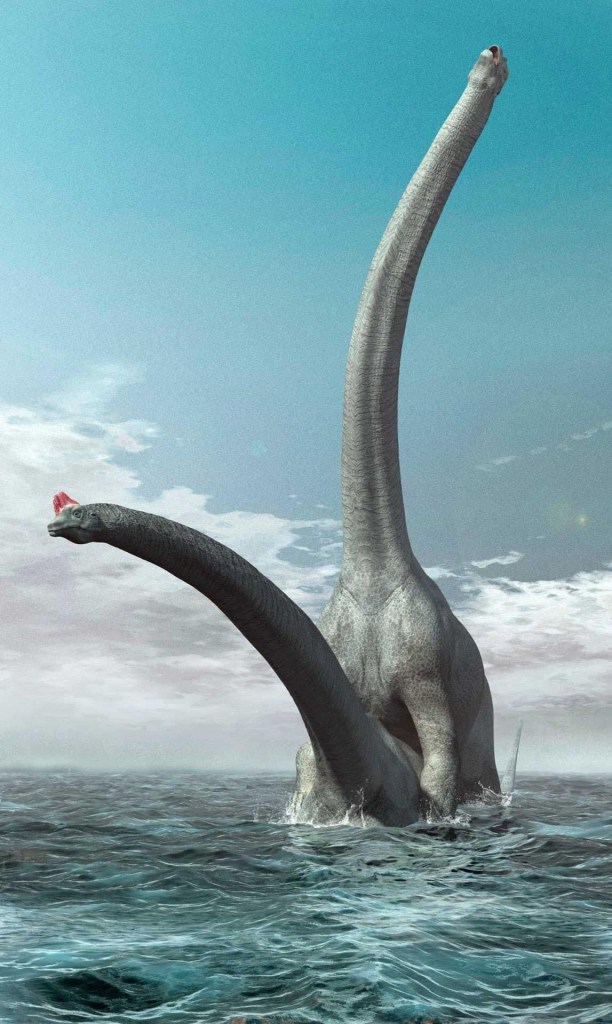
Dino Luv

It’s National Dinosaur Day and here is a thing I’m not sure I’m glad I saw on Twitter. It’s a pair of sauropods in flagrante delicto about 120 million years ago. The setting is more romantic than realistic, given that these things shoveled down vegetation by the ton and probably didn’t go splashing around the waters off the coast of what is now Texas in what is now the Gulf of Mexico, or perhaps off the coast of Oklahoma in what was a vast shallow sea that bisected North America from north to south and explains all the fossils of giant marine reptiles they dig up in Kansas. Add a few palm trees and huge ferns for a probably more realistic portrait of what two huge dinosaurs looked like fucking, something I had never thought about before but is burned into my memory now. Incidentally, you’ll notice the male came first. Some things never change.

This extraordinary painting “Sauroposeidon dinosaurs mating” is the work of
José Antonio Peña, I believe in 1993.

Pterodaustras

I see a lot of paleo art on Twitter, and Gabriel Ugueto is among the best of the paleo artists. Here’s how he envisioned a flock of Pterodaustro maybe 105 million years ago. It’s believed they would use their bills like flamingos do, as they share some of the same unique bill features, and probably ate similar sorts if food, being that 105 million years ago the same sorts of eats were available. Some paleontologists suggest they may have even shared a pink color, which Ugueto hints at here by setting this painting in the light of dawn or dusk. These guys would have been bigger than flamingos, though, with wingspans about 8 feet wide. They weighed maybe nine pounds, not much of a Thanksgiving feast on those hollow reptilian bones. They were long gone by 65 million years ago, but other pterosaurs were there, huge weird gorgeous flying soaring things that up and disappeared when the asteroid hit the planet and killed nearly everything. Oh well.

I still can’t decide if Godzilla could kick the T. rex brothers’ asses or not.

Watched T-Rex: An Evolutionary Journey last night which was so apallingly bad I was embarrassed I was watching it, but just as I was about to switch it off it ended. If you like cheesy Japanese anime you’ll love it, as this was cheesy Japanese anime pretending to be a paleontology documentary. Not that the dinosaurs were actually anime, they were CGI. It’s just they acted like they were in an anime. A pair of very early proto-tyrannosauruses roam around China. They leap about like martial artists, leaping and kicking and biting. Sure they’re not much to look at, just little fellas, but they got gumption. They roar a lot. Tens of millions of years pass and things are getting rough at home. They decide to join the epic prototyrannosaur migration from China to North America. It gets Lord of the Ringsy pretty quick. Magically, a land bridge appears. I mean they explain how, but in the story it just appears. They show up in North America, run into some sort of allosaurus. They attack by leaping though the air like those anime martial arts fighters and kicking. The allosaurus smacks one away where it lies bleeding and twitching, losing a tooth which a paleontologist finds in the American west in our time. Millions more years pass and our little fellas have become the biggest dinosaurs ever with big brains and jaws like you wouldn’t believe. They work in hunting teams like dolphins or people and are way faster than the T. rex in Jurassic Park. The strongest—and this show is all about the strongest, this is paleontology for men—can run 50 mph. I suppose that is debatable. They also leap like martial artists onto the backs of remarkably fast moving plant eaters and kick and bite and kill them, roaring triumphantly. They survey all they rule from the peaks of mountains, roaring. They find a descendant of that punk allosaurus and dispatch him with a leap and a kick and a bite, and then roar triumphantly. You’ve never heard such a noisy reptile. If there are any female tyrannosauruses we never see them. We never see the juveniles either. Not even eggs. This is a man tyrannosaur’s world. Then the asteroid comes.

There’s a lot of interviews with paleontologists who probably regretted it immediately, a lot of cool looking fossils and sciencey bits, and the CGI dinosaurs are pretty good, if decidedly warm blooded in their behavior. Very warm blooded. No lumbering elephants these guys. Actually, a lot of the paleontology seems more or less accurate, like a science anime fairy tale. Incredibly, it’s an NHK—the Japanese television network—production, though it’s more like a Toho movie than a science documentary. Definitely was the most ludicrous dinosaur documentary I’ve seen since Destroy All Monsters. I still can’t decide if Godzilla could kick the T. rex brothers’ asses or not. He could breathe fire, sure, but these guys could leap and kick like an anime Bruce Lee.

One helluva huge icthyosaur

Another great painting by paleoartist Gabriel Lugueto. As only part of a jaw bone has been found of this particular species (at the base of a British seaside cliff) and since matched to some other enormous stray bones in British museums, this is some wild extrapolation, but still, it belonged to one hell of a huge ichthyosaur. 85’ long is the usual paleontological guesstimate, which would put the Lilock Monster (so dubbed by a British tabloid, no doubt) in the same size range as the blue whale. Or should it be the other way around. Anyway, the scene imagined here would’ve been sometime between 200 and 235 million years ago (the Late Triassic). The seabirds pictured would actually have been pterosaurs, as I don’t believe birds had evolved sufficiently as yet to fly and soar like seabirds do now. Pterosaurs were filling that niche, and would until that damn asteroid wrecked everything. Neither they nor ichthyosaurs survived that. Our ancestors did, squirmy little insectivorous things probably with all the charm of a shrew. Thus we’re here, apes that can talk and write and think things, writing about ichthyosaurs.

“A small group of the gigantic Lilstock ichthyosaur swim near the coast of Late Triassic Europe. This taxon is here reconstructed as a Shastasaurid. Numerous pterosaurs flying around”—Gabriel Lugueto on Twitter

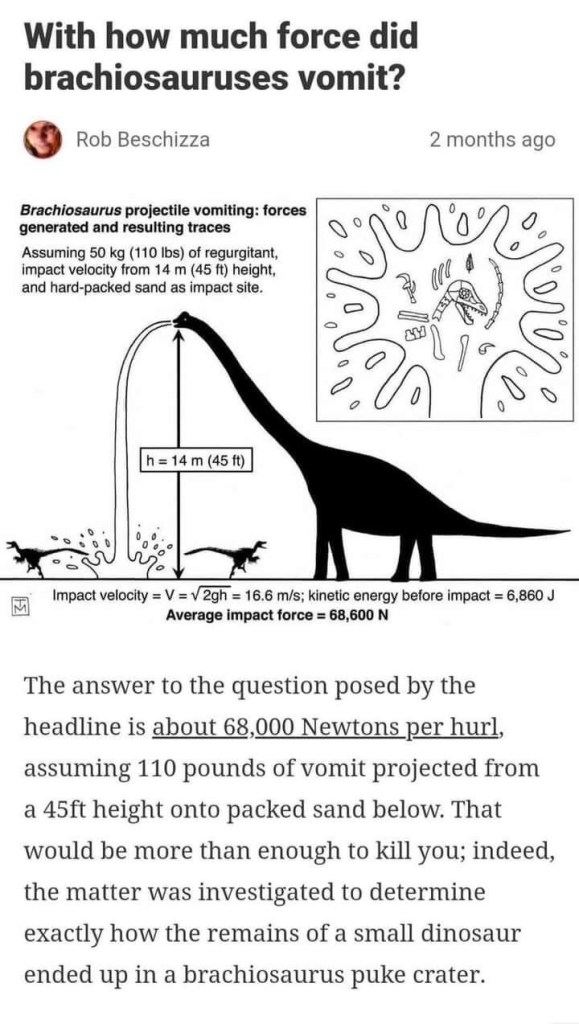
Brachiosaurus puke crater

Apparently a brachiosaurus could projectile vomit with such force that it killed a small dinosaur who had the misfortune of being in the way. The poor little guy’s fossilized remains were found in a brachiosaurus puke crater (well, brachiosaurus vomit crater in polite company), I assume smooshed under the fossilized remains of brachiosaurus vomit. Not only was a brachiosaurus tall enough and ate enough so that a stomachfull of foliage would be vomited with such force that it could kill even you, had you been in the right spot, but you would be squished to death in one of the most disgusting ways imaginable. It’s something never explored in Jurrasic Park.

The notion that a critter could vomit so hard that it could leave a hole in the ground like a mortar shell is something I had never really thought about before. But as brachiosauruses were nearly 100 feet long from schnoz to the tip of the tail (and reaching about two thirds of that tall) you have to assume that the length of their alimentary canal from stomach to mouth was at least half the body length, so it would take an extraordinary amount of force to puke a stomachful of giant fern tree leaves (or whatever they ate.) Remember when you were so drunk you projectile vomited a pizza and three pitchers of beer? No, of course you don’t, you were drunk. But remember when your roommate did? Let’s just say it was your roommate then. Well, that pizza and beer came up a mere two or three feet from the stomach, certainly not enough to kill the person he (or you) vomited on. Now multiply the power of that projectile vomiting a zillion times and you have a brachiosaurus projectile vomiting. We’re talking vomiting with such force that a stomachfull of swallowed vegetation became a genuine projectile, one that leaves an actual shell hole. Basically, it would be a mild mannered vegan sauropod nearly as big as anything that ever walked the earth acting like a cannon. I’d never thought of that before. They’re always so nice in the cartoons and movies. Nor had I ever thought of the fact that such a vomit hole could survive in a sedimentary layer laid down 150 million years ago and be so recognizable to paleontologists in our time that they’ve dubbed them brachiosaurus puke craters.

Brachiosaurus puke craters. No wonder I wanted to be a paleontologist when I was a kid.

(And here’s the marvelous tweet that set me off on this tangent. Thanks to Rob Beschizza for the thinking and the math and the drawing.)

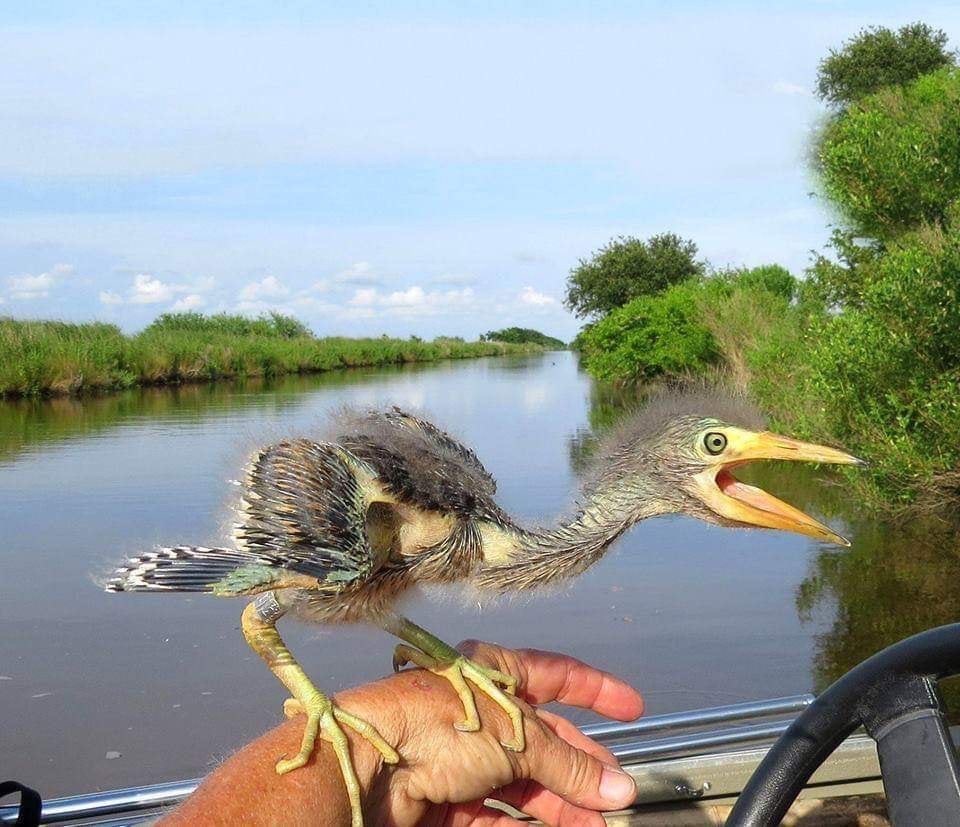
Greenheronsaurus

Pretty damn close. This baby green heron doesn’t have any teeth, which a dinosaur would have. And a heron’s wings are much, much stronger than any of its ancestors would have had in the dinosaur era. Feathers, too, have undergone sixty five million years of continuous evolution since the dinosaurs. But for us laypeople (layhumans?) it’s awfully difficult to look at this guy and see the differences between it and a dinosaur sixty-five or a hundred million years ago. It’s a good thing for Stephen Spielberg that Chinese paleontologists uncovered the mother lode of feathered dinosaurs in China after the Jurassic Park series had begun. Well, they’d already been digging them up, it just took a while for the realization to sink in with the public, who were having problems enough trying to accept that an asteroid had ended the Age of the Dinosaurs in a flash. Those were the days when if you knew that tyrannosauruses had feathers you kept it to yourself. You didn’t blurt that kind of thing out, and you certainly didn’t say in it front of the kids. You see that Tyrannosaurus rex chasing Laura Dern? The one that nearly chomped down Jeff Goldblum? It looked like a huge, psychotic chicken! The ushers would deposit your ass out on the curb before you could say Zhuchengtyrannus magnus.

A baby green heron. Photo by JJJ Frank (from the Fascinating page on Twitter)