Cats–a forgotten draft

(an early draft of Cats, 2012)

Mockingbirds are strafing one of the neighborhood cats. A whole little mockingbird community, who spend all night and days shrieking at each other (at 3 a.m. it was a battle of car alarms) have banded together to dive on the hapless cat, who is frantically looking for cover. The birds are all fired up, having just driven off a pair of nest robbing ravens. So much violence.

I find it hard to feel sorry for Fluffy. Fluffy (not his real name) is a friendly cat, yes. Cute even, on occasion. None of the people around here have any issues with him. But mockingbirds have damn good reasons for taunting him. Cats love stalking and pouncing on birds. People deny that their cat does — kitty would never kill a bird — but pet cats let outdoors have wiped out a lot of urban bird populations. They can’t help it. It’s what they do, cats. They’re hunters. And so are coyotes, and all those pet cats people let outdoors provide a steady diet for coyotes. I suspect we wouldn’t even have populations of urban coyotes if it weren’t for all the house cats people let outdoors. The more cats people have, the more cats there are outside, the more coyotes can survive living among people. You could probably graph the rise in the popularity of cats as pets with the increase in the urban coyote population. You could, but you’d have a hard time getting laid afterward.

We used to have a local population of feral cats. Some big mean toms. They’d fight all night, those eerie, annoying cries of their’s waking everybody up just in time for the burst of intense violence that followed. Sometimes you’d hear cat bodies being thrown against the side of the house with some serious force. Amazing how much energy a cat can expend in a fight. Not for very long. Cats are anatomically sprinters, not long distance runners, like dogs. All their energy has to be in astonishing bursts, since the oxygen in a cat’s blood is quickly depleted. Hence their contests are more build up than action, and size almost always wins. So the biggest, meanest cats ruled our neighborhood. Nearly all of them were feral. The pet cats would skitter home beat up and bleeding. It was getting to be a problem. Cats making a helluva racket all night. People yelling at the cats. No one getting much sleep.

Then a pack of coyotes moved into the neighborhood. End of problem. The endless war cries of cats were replaced by the occasional high pitched yelps of excited coyotes. You’d hear them running down the street on the hunt. It’s weird, a quiet neighborhood and the yelping of wild canines. Like all this civilization wasn’t even here. Like it has been stripped away for a moment and you could hear what it was once like. It’s so spooky it’s thrilling.

The coyotes ate all the stray cats. And they ate a lot of pet cats, foolishly let out by their owners. They ate a lot of little dogs, too, right in their back yards. Sad little flyers appeared on telephone poles. Rewards were offered. There’s one right outside now. I can see it from my window. The little dog is just darling. The reward is one thousand dollars. There’s a lot of money in Silver Lake.

I like cats. And I dig coyotes. And birds. Ours are indoor cats only, so off the menu, and birds are off theirs. They watch the birds from the window. My wife feeds birds. Sparrows, finches, a couple kinds of doves. Every once in a while a scrub jay drops in and scares off all the other birds. Not as often as before, though. It’s been a while since I’ve seen a lesser goldfinch, a hooded oriole, or a towhee. A long time. There were more bird species in Silver Lake when we moved here in the 80’s. Especially here near the river. The explosion in the pet cat population coincided with the disappearance of several species. Birds like the towhee which spend a lot of their time on the ground were just too easy for cats. There are far more cats now than there were twenty years ago. Everyone has a cat or three. Crazy cat ladies don’t seem so crazy anymore, merely eccentric. People leave food out everyday to feed the strays to feed the coyotes. Funny how coyotes might increase the bird population. I used to think they might. Haven’t noticed it, though. [I do now, in 2016. Even the towhees are back.] For every cat eaten there must be two more cats being brought into people’s homes. People are just mad about cats.

There are several theories about just why. The weirdest one is that cats have passed on a parasite that has altered our behavior and makes us pay lavish attention to our pet cats. Parasites can do that, nature is full of examples. The theory got lots of attention, a big story in The Atlantic, and the scientist behind it was all over television. The science is a little sketchy, though. Let’s just leave it now and agree that people are nuts about cats. And cats are nuts about killing birds.

Cats are natural killing machines, remarkable animals, though we don’t really notice. The design hasn’t changed much since it’s inception around 30 million years ago. That cat, the proailurus,or dawn cat, looks remarkably like your cat.

Proailurus

It was even about the size of your cat. Amazing how little things have changed in thirty million years. The head seems a bit larger now, which might be to make room for a larger brain. The proailurus’ jaws seem extended a bit, too, more dog-like, and the evolutionary transition to a modern cat jaw probably accounts for the larger head of the modern cat. The one pictured above has decidedly more weasel like proportions…or less kitten like. The tail of today’s house cat is maybe two thirds as long. Perhaps because modern cats use their tails to communicate and a longer tail could not be held straight up as easily. A tail straight up implies fear, for instance, and held aloft with the top few inches at a 90 degree angle shows friendliness. That larger jaw of modern cats also helps with communication, I’d guess. Small sounds resonate more inside a larger mouth, vastly increasing the cats vocabulary. House cats have an extraordinary range of sounds they make to each other. Some they make to us. Some they make for each other. They’ll call to each other and you’ll try to get their attention and they completely ignore you. Some kind of intense cat to cat thing going on, and we’re not supposed to know, like when two people break into a language you don’t know with you standing right there. When they want to talk to you they’ll let you know.

Felines have been compared to sharks as being perfect predators. Perfect hunting machines. And like sharks, once the initial design was laid out there wasn’t much alteration needed afterward. Of course sharks go back over 400 million years, but evolution in the open ocean, where conditions change vary little over enormous stretches of time, can proceed much more slowly than on land. The environment on solid ground is much more volatile. Species are under constant pressure to change or go extinct. Think of how humans have altered in just a few million years. Indeed, look at how much size variation there is even with our own species (writes the six foot five inch man). Not cats, though. All the small cats, from the cute, vicious little sand cat to the largest of the small cats, the cougar (which purrs just like the domestic short hair in your lap) come from proailurus, and all look very similar. Today’s big cats–lions, tigers, panthers, leopards, cheetahs–all descend from pseudaelurus, which itself descended from proailurus.  Weird to think about, he says, a housecat staring at him as he types.

The action outside my window has abated, for now. The mockingbirds are back up on their branches, quiet, looking for threats. Fluffy is up on the neighbor’s porch, glowering. And as the sun sets a siren wails and the coyotes come to life.

Contagious cancer

In shellfish, the Live Science headline says, cancer can be contagious. “Recently scientists discovered that cancer cells can sometimes escape an organism and spread to others. These cells are clones that are nearly identical to the originals, save for mutations that might have popped up since they diverged from the initial cancer cells.”

Genetic analysis of the cancers and their hosts revealed that in nearly all of these cases, the genetic makeup of these cancer cells did not match those of their hosts. Instead, the cells came from other animals. Then comes the kicker. The finding suggests that transmissible cancers might be far more widespread than previously thought.

I knew that there was a contagious facial cancer afflicting Tasmanian devils (and in fact, decimating the population.) They nip each other in the face like you and I shake hands, but while we once spread warts (mom told us) they pass on a horrific cancer. And I didn’t know they’d found contagious cancers in dogs, spread by puppy love. But these involve intra-species transmission, though, one he dog to a she dog, or one snarling Tasmanian devil to another. The thing about this news story, though, is that they’ve found a cancer had spread from a clam to a mussel, that is, inter-species transmission. And while there’s no way you or I will ever catch this cancer–we are way too different from clams and mussels, even the dumbest of us–it does mean that we might be able, some day, to catch a cancer from another primate species, at least. Or maybe even from Fido, wagging his tail every time you look his way? But as no cancer has jumped from human to dog or vice versa in the 20-30K years that dogs (née wolves) and people have been hanging together (I assume we could have detected any such transmission genetically) it seems unlikely. Specific cancers are too tied into specific genetics to be able to just flit from one mammal species to a distantly related other, and people and dogs and all their carnivore and primate predecessors and their pre-carnivore and pre-primate predecessors have each been on their merry but separate evolutionary way for maybe 80 millions years, as dinosaurs still stomped about. And though both are mollusks, the last common ancestor of mussels and clams existed over 480 million years ago. Yet half a billion years later a clam can “catch” cancer from a mussel. A half billion years is an incredibly long time, both in terms of deep time and genetics.

We might catch the same sort of cancer from the same carcinogen as a dog, but it’s highly unlikely a dog’s cancer cell could settle amid our healthy people cells and metastasize. But here a cancer in mollusks that has done just that. No one knows how, though there is one revolting hypothesis that it comes in excrement that floats on in with sea water, a mussel leukemia transmitted in the way we transmit cholera, though all we ever did was drink and bathe in the water, while mussels eat and breathe it. The sea is their air. Imagine breathing in cholera laden air, as if all the old ideas of bad air causing epidemics (“malaria” comes from the Italian for bad air, mal aria) were true. Perhaps that is how this cancer (a mussel leukemia) spreads. Not that the mussels are thinking about it. But I am, and the entire idea is creepy. You have to wonder how often this happens. In a small population a contagious cancer could theoretically push a species to the point of no return. Perhaps even a hominid species. What have the evolutionary implications been over the past half billion years as cancers crossed from one species to another closely related species? Has genetic variation been driven, in some small sense, by mutations that allowed an individual to fend off the wandering cancer cells from a closely related species that had devastated his otherwise identical siblings?

Thinking about cancer is bad enough. But thinking about contagious cancer gives me the willies. Change the subject, please.

Stromatolites

The World’s Oldest Fossils Are 3.7 Billion Years Old says the headline. They were discovered in Greenland. Apparently some Aussie paleontologists went all the way to a just as uninhabitable part of the earth as the Australian Outback–just colder–to find fossils of lifeforms older than anything in their own country.  And it’s not like they were looking for them–I have no idea what they were looking for, actually, it doesn’t say–they just happened to look closely at some rocks poking out of the melting snow (you rarely hear paleontologists complaining about global warming) and immediately recognized the distinctive shapes held therein. Stromatolites!  And if there is one place on earth with rocks older than Australia, it’s Greenland. Both are mostly craton–that is big pieces of ancient land that have sort of wandered about the globe with the tectonic currents, not being ground up by continental plates and belched back up as new igneous rock formations in the mid open trenches that stitch the ocean floor. Iceland, the whole island, is part of that grinding and belching process that somehow is above sea level. As such, Iceland is about as opposite from Australia or Greenland as any place on the surface of the globe can be. There are no fossils on Iceland, it is far too new and the rock was all basically molten not long ago. Australia and Greenland, though, were in large part land that was formed maybe four billion years ago, when land was first invented, and in Australia at least there is still some of it in virgin condition (we can’t see most of Greenland yet, it’s still ice and snow covered). Both the Australian and Greenlandic cratons contain incredibly ancient rocks, and where sedimentary rock was laid down a couple billion years ago in ancient shallow seas, you will find incredibly ancient fossils. The land today is so untouched in places that in the depths of Australia there is a famous fossilized beach, you can even see the ripples left in the sand by the waves. Groovy, in an incredibly ancient kind of way.

Of course, we are not talking dinosaurs here. We are billions of years before dinosaurs fossils, before almost anything even. Fossils from that far back are few and far between. Mainly, if not exclusively, they are stromatolites. There were untold jillions of stromatolites then, vast immobile herds of stromatolites luxuriating in the young planet’s overheated waters. Indeed, Earth was a young planet full of stromatolites with no one to eat them. It was sort of a vegan paradise. Since then, though, predators were invented and stromatolites have sheltered in the less hospitable places on earth, overheated and hypersaline. There they thrive, ignored, virtually unevolving. Were we to zap one of the fossil stromatolites with a time machine gun, it wouldn’t look much different than they do today. Hence they call today’s stromatolites living fossils, like coelacanths and horseshoe crabs and cycads and the Rolling Stones.

Australia had the oldest fossilized stromatolites in the world, nearly three and a half billion years old. Or they did until the Australians I mentioned above went wandering about the ancient rocks of Greenland and found the newest oldest fossils. Two hundred and twenty million years older, in fact. To give you an idea of how big a span that is, two hundred and twenty million years ago we mammals had just been invented. We were just squirmy little shrew like things, not very appealing. And birds hadn’t been invented at all. That’s how big a span of time two hundred and twenty million years is. And these Australian paleontologists found stromatolites in Greenland that were two hundred and twenty million years older (3.7 billion years old) than the celebrated 3.48 billion year old stromatolites from the Marble Bar Formation in the Pilbara region of way the hell out there Western Australia. Imagine having your oldest fossils rendered penultimate, just like that. By your own countrymen, no less. What a blow to the Australia paleontological ego, if not the body politic itself. The Government of Western Australia’s website even has a whole page boasting of “the world’s oldest known examples of fossil stromatolites (3.45 billion years old), found near Marble Bar in the Pilbara.” Ahem. Our trio of Australian paleontologists–we’ll leave them unnamed–will be a very popular bunch in the roadhouse in Marble Bar, the metropolis in the Pilbara closest to the now second oldest fossils, that’s for sure. No more free beers. Though they did push back the evolution of life on Earth even further than had been imagined. If relatively complex (by bacterial standards) stromatolites were flourishing 3.7 billion years ago, then bacteria itself must have been around much earlier than that. And the planet itself is only 4.5 billion years old. Life started here much earlier than we thought possible. I doubt, though, that would impress the locals at the roadhouse in Marble Bar. Their metropolis (population 208) was famous for one thing, and one thing only, the world’s oldest fossils. And now you’ve told everybody that they are the second oldest?

But even though the Pilbara stromatolites are a mere 3.48 billions years old, Australians can still brag (“some of the best examples of living microbialites“) that they have living stromatolites, if you call that living. Because several hundred miles to the southwest of Marble Bar, as the emu flies, is Shark Bay, and in the hottest, saltiest part of Shark Bay is a thriving stromatic metropolis. Probably the world’s most famous living stromatolites, actually, even David Attenborough paid a visit. Life forms just like this, he said with breathless and beautifully enunciated excitement, came to be in the Pre-Cambrian. He didn’t touch one. They’d feel like a slimy lichen. Which is sort of what they are, big stacks of slimy lichens, mostly made of cyanobacteria, and nowhere near as cuddly as the wallaby Attenborough had doubtless been cavorting with a day or two before.

However, despite their sliminess, these living stromatolites mean that Australia has had conceivably the longest continuous stretch of communal living on the planet. Even as the Australian craton wandered about the earth, bumping into other cratons and slowly bouncing off again, it had stromatolites. Even when the planet was wrapped in ice–the Snowball Earth hypothesis, a scary one if correct–some Australian stromatolites clung to some little saline hotspot. And they are still there, building up into stromatolites a couple feet high mat by microbial mat, like those layers of lichen you see on rocks but with little grains of sand worked in and held fast by slimy bacterial excretions to provide the structure the way we use girders to build our skyscrapers (though to a cyanobacterium a two foot high stromatolite would be millions of times taller than the Empire State Building.) They link their little flagella together somehow too, like holding tiny bacterial hands, and then they sit there and metabolize. That’s about it. That is what stromatolites so. No scurrying about like in an ant colony or a beaver dam or Los Angeles. Just four billion years of stromatolites doing essentially nothing, but doing it together. There are so many possible jokes here I can’t decide on just one so never mind.

Meanwhile, Greenland gave up on stromatolites permanently (or at least until the next super continent congeals in a half billion years or so) when Pangaea broke up and Greenland scooted pole-ward. Way too cold for stromatolites up there–they like their water hot–and not enough hypersalinity (though there are also examples of freshwater stromatolites in a few places around the world, including a pond that is only forty years old.) So while Greenland has the oldest stromatolites, if Greenlanders want to see their living salt water equivalents they have to go nearer the equator–Mexico, Brazil, the Bahamas. Or about as far away as a Greenlander can go, Western Australia, which is where those Aussie paleontologists are now, being yelled at by drunken Pilbarrans angry about being the second oldest. There goes all that tourist money.

Anyway, many years ago, back in my own personal Pre-Cambrian era, I decided that one day I’d write something about stromatolites. Now I did. I thought then that there would be more of a sense of achievement, of completion. Instead I feel empty and stromatoloid. Some bucket list this is.

stromatolites

Shark Bay stromatolites. Feel the drama.

Monotremes and you and me

Found this buried in among the drafts and I have no idea when it was…

It began as a post about a donkey in a hole. Farmer shovels in dirt, donkey takes a step up, farmer shovels in more dirt, donkey takes another step up. Finally the donkey is out of the hole and the hole isn’t even a hole, it’s full of dirt. The lady had thought maybe it was a real story–the picture of the donkey in the hole–and hated the farmer. Not sure why, but on Facebook you have to hate something. Me, I hate cat pictures. This lady hates farmers with donkeys in holes. I stopped paying attention. A day or two later I check in again, unintentionally. The thread had gone off topic, from donkeys to platypuses. Placental mammals to monotremes. The lady hated platypuses. Why do you hate platypuses, someone asked. They lay eggs, she said. Another guy said it’s because they’re monotremes, sort of a link between mammals and reptiles. The lady said eww….

Eww? Have you ever seen a platypus or an echidna, I asked. I mean, they’re adorable. Personally I love echidnas. I’ve never seen a real platypus…there aren’t any outside Australia, not even in zoos.  They have laws keeping them there. Echidnas, though, are in zoos all over the place. Some come from Australia, some from New Guinea, they look kinda like hedgehogs and trundle about looking for ants mostly and are cute as hell. The L.A. Zoo had a whole indoor display full of eucalyptus and koalas and echidnas. The koalas mostly slept, the echidnas trundled. I was being kind of Facebook obnoxious, I have to admit. But I was only beginning.

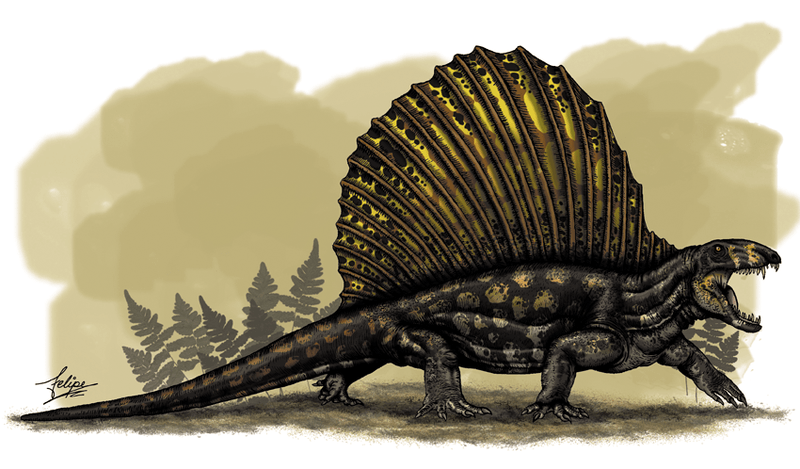
Because to be one of those really obnoxious Facebook people, I explained that a monotreme is actually a living example of one of the earliest stages of mammalian evolution, an early stage on the track which went from which from monotremes like echidnas and platypuses to marsupials like kangaroos and wallabies to placental mammals like you and me. And to be even more incredibly obnoxious, I explained that mammals didn’t evolve out of reptiles, synapsids did. The early synapsids are called  pelycosaurs, the most famous of which is the sail-backed dimetrodon.

Dimetrodon, about 275 million years ago.

Every child’s  favorite pelycosaur, the Dimetrodon, about 275 million years ago.

Most synapsids were much less exotic looking, however. And one, sans sail, evolved into therapsids, aka the mammal-like reptiles, from whence we eventually came.

The weirdly cat-like Pristerognathus, about 260 million years ago.

The weirdly cat-like therapsid Pristerognathus, about 260 million years ago.

Alas, nearly all the pelycosaurs and therapsids died out in the Permian extinction event (which took out 90% of all know species on earth, actually). Just before that, though, in the late Permian, a line of therapsids had evolved into the way more mammal like cynodonts, some of which somehow survived the Permian extinction to continue in the Triassic, a world virtually bare of species and ripe for dramatic evolutionary change, especially among reptiles. Hence all those wacky dinosaurs. Cynodonts, in comparison, seem much more mundane and functional. No cynodonts became tyrannosaurs or apatosauruses. None ever rose out of our imaginations to level Tokyo.

But one line of cynodonts that had survived the extinction eventually evolved into early mammals sometime in the latter half of the Jurassic, little shrew looking things that hid in the shadows from dinosaurs and were predecessors of the echidna and platypus and in the long run, you and me. But it would take another extinction event, this time a massive meteorite or comet, to end reptile dominance and enable our skulking little shrew-like predecessors to evolve into a zillion species and fill niches world wide. Actually not all were shrewlike, some may even have been downright cute, for egg layers:

At eighteen inches long, castorocauda was more like a platypus than a shrew, 160 million years ago.

160 million years ago the castorocauda, at eighteen inches long, looking more like a platypus than a shrew

However, you and me, being primates, probably did evolve out of the sneaky little shrew like creatures skulking about in the dark. But we didn’t evolve directly out of reptiles. And we are not related to dinosaurs at all. What did evolve directly out of reptiles, of course, were birds, which actually are dinosaurs, the only surviving dinosaurs who then radiated globally into a zillion species in the global emptiness follow mass extinction. And just as chickens are dinosaurs, we humans all still synapsids, like the dimetrodon. In fact, synapsids are much older than dinosaurs, which means that birds are actually a later creation than are mammals. Way later. Hence we keep them in cages and dice them into McNuggets. And when you look at a raven and think that’s a dinosaur? It could be looking at you and thinking and that’s a synapsid? Except all it’s really thinking is that it wants your sandwich.

What does this have to do with a donkey in a hole, someone said.

Humans being are scared because being scared is human.

Terrorism in Western Europe Used to Be Much Worse read the headline in Mother Jones. Someone asked if terrorism is so much lower than it was forty years ago–see the chart below, the difference in scale is dramatic–then why is fear up so much?

Probably because there is nothing else to be afraid of. Human beings, having evolved under constant predatory pressures, are by nature very fearful. Back in the 70’s Americans were scared shitless of terrorism, but we were also worried about World War 3 and an incredibly high crime rate and some truly scary serial killers. Fear was a continuous presence, and there was much to be genuinely afraid of. Now there is a lot less to be afraid of, very little even. So we focus on terrorism. People will always be terrified of something.

Our very intelligence, the incredibly high level of human cognition, developed in response to our terror of predators. It probably even was one of the factors in the development of language. (Think of vervet monkeys, with their distinctive cries of danger for leopard, snake, eagle.) We can’t live without fear. People who are naturally without fear literally have something wrong with them…. and those eastern techniques people use to attain inner peace–that is, freedom from fear–require extraordinarily intense concentration and practice to overcome our intrinsic fear.

Homo sapiens are the only surviving human species out of dozens, and it is assumed that nearly all the other species were driven to extinction by predatory pressures. Life in the plains was extremely dangerous. We remain the sole survivor because our ancestors were the only one who developed technology to help us fight back, and did so an incredibly long time ago. Homo habilis had developed tools way over two million years ago, which means they must have already been using stones as missiles, much like baboons do. Our survival strategy was probably much the same as baboons–groups that defended aggressively against predators, except that baboons can live in very large groups because they are primarily plant eaters, and we were forced to live in smaller groups because we ate mostly meat. That made us much more vulnerable to predators–especially leopards (in fact, leopards still kill scores of people annually). Therefore we had to have a much more acute wariness about leopards (which are ambush hunters), which helped us survive where every one of our competitors failed. Being scared all the time was not only a survival strategy, it made us human.

Incidentally, of the four surviving genuses of hominids, three–orangs, gorillas and chimps/bonobos–all live in dense forest, which protects them from predators. We are the only genus that survived in open country, from H. habilis through H. erectus to H. sapien. And we did that by be incredibly wary. Even now, living in completely artificial homes surrounded by all this technology and never eating anything we killed or harvested ourselves, we will always find something to be freaked out by. Fearing sudden attack by terrorists is not that different from fearing an ambush by a leopard.

Leopards, in fact, may have evolved as hominid eaters, as both they and we evolved as species at the same time. As prey we may have actually been a prime driver in their evolution. You look at a leopard and you might be seeing a cat designed to kill you, specifically. There is no other predator designed to eat us. Leopards certainly are much more adept at hunting us than are lions or cheetahs. Leopards even have human-specific methods of killing us, preferring to catch people indoors while they sleep. They haunt Mumbai by night, taking a dozen or so of us in a bad year within the city limits. They are epicures of humans as food, oenophiles, sometimes killing one of us with quick bites to the neck, then tearing open the throat just to lap up the blood that pools on the floor. They drink their fill and slip out the way they came in, unseen, leaving the meat uneaten.

After writing that, I walked over to make sure the door was locked. There are killers and terrorists everywhere.

4093_people_killed_by_terrorist_attacks_in_western_europe_since_1970_n

When octopuses rule the earth

The octopus is an alien, an utterly confused tabloid piece read. One of those English papers. It quoted a scientist. One never jokes like that to a tabloid. Of course, the piece ran riot across Facebook. It may have been old news about the octopus’ nervous system, a week or two old anyway, but no one had mentioned the alien quote. It must be an alien, a marine biologist said. Friends of mine posted this in all earnestness. A zillion objections ran through my head–DNA was one, why would an alien share so much DNA with sea slugs and clams and snails–but what really stuck out for me was an octopus’s life span. If it’s some sort of advanced alien they sure don’t live very long.

Most octopus live from six months to two years, though a few species live up to five years. That’s it. They reach the end of that span and the body ages to the point of death. I’d always thought that the tragedy of the octopus is that it’s life span is so short there’s no way for individuals to either acquire decades of knowledge or pass on a culture. Mating is usually the cause of death, indeed of the process of death itself, the males die within months, the females not long after the young hatch. Oddly enough, females do because they stop eating while protecting the brood, they’ve done experiments that led the females to resume eating right after egg laying which led to much longer life spans. Had there been a mutation that allowed a species to do what was done in the lab then imagine the difference…. Unfortunately, no such mutation occurred, or remained, apparently starving oneself to protect the brood has evolutionary advantages. (Nor has there been found a way to stop the male from aging suddenly after fertilizing.) So advanced invertebrate intelligence has been held back by invertebrate reproduction. Which always strikes me as incredibly sad.

Still…the octopus has been around for a quarter billion years, and mammals didn’t even exist a quarter billion years ago (we were still non-mammalian cynodonts, the mammal-like reptiles that fully mammalian cynodonts–that is, mammals–evolved from maybe 25 million years later). Life in the sea is far less dynamic and less dangerous than life on land. Species can survive vastly longer before extinction, and their environment changes much more gradually. Even today’s climate crisis won’t threaten the existence of octopus species in the long run–after all, they emerged about the time of the Permian Extinction and glided through the end of the Cretaceous, when the planet was smacked by a giant meteor and rent by massive vulcanism at the same time. So octopus species–there are about three hundred known now–are quite likely to be on the planet for a long, long time.

And all it might take in that long, long time is a genetic mutation that, say, delays the onset of reproduction by a few years, long enough for octopus culture to increase in complexity and be learned by other observant octopuses, and then that more complex culture giving enough of an evolutionary advantage so that the mutation would not die out competing with octopus who reproduce at the current age. It was Homo habilis, a couple million years ago, who first began human culture in proto-human form, making tools from rocks by methods that would have required careful watching to master. Doesn’t this happen among some octopus species now? This would certainly have to be learned. The beginnings of culture are there already, and Amphioctopus marginatus and some similar species from around the Pacific is at the same stage with their coconut halves that Homo habilis was 2.8 million years ago shaping rocks into hand axes. Apparently one local population of Amphioctopus marginatus (or a related Amphioctopus species) figured out the body armor thing (perhaps using bivalves shells rather than coconut shells) just as a family or cave full of Homo habilis conceived the shaping of stones.

But while Homo habilis could live twenty, even forty years, Amphioctopus marginatus live from six months to a year. Imagine that–octopus have created and passed on tool using methods (by observing and copying) in a life span that, for any homo species, would scarcely go beyond infancy. But there is nothing saying that a mutation that enabled a longer octopus life span can’t happen and survive long enough to create a new long lived octopus species. It doesn’t seem like it would be an impossibility. Indeed among cephalopods the nautilus lives twenty years or more (not that far from that of homo habilis), and doesn’t even reach sexual maturity until fifteen, or three times longer than the longest octopus life span. Nor does a nautilus die after a single reproduction. However, the nautilus is more similar to the cephalopods of five hundred million year old than to octopus (and squid and cuttlefish.) Either at some point the nautilus developed iteroparity (multiple reproductive cycles) and a longer lifespan, or octopuses (and squid) switched to semelparity (a single fatal reproductive cycle.) Either way, it seems that the chain of mutations to increase the octopus life span should be theoretically possible within the genome of the octopus. (Mutations do not materialize out of nothing, but have to be possible within the genes and possible growth rates already within the parents’ genome. You can see that range in sexually dimorphic human beings, a man six and a half foot tall flirting with a woman four feet ten.) So there’s nothing saying that a quarter billion years from now (as I said, evolution is a vastly slower process in the ocean than on land, where it took a mere thirty five million years to go from monkey to human being) a long lived species of octopus will not be the smartest thing ever on earth. Some of them are using tools already, and I know some humans that can’t even do that.

Octopus habilis.

Apes with extraordinary cognitive abilities

Once you realize that every single human being there is has inside their skulls the most complex thing that we know of in the entire universe, it gets a little weird. There are over 7 billion of these brains out there right now, all over the planet, each vastly more complex than the universe it exists in (which, after all, is mostly empty space.) Dig these numbers: a human brain has about 86 million neurons, and roughly ten times that many glial cells, or upwards of a billion. Each of these neurons fires five to fifty times a second and each of these neurons has up to ten thousand connections with other neurons. The estimates for the total numbers of synapses (i.e. the connections) between our neurons run from 100 trillion to 1,000 trillion (or one quadrillion). These synapses connect via dendrites (little filaments that grow from the surface of a neuron) and there are more dendrites than are used by neuron at any given time, so the potential number of connections could be one million billion (or one quintillion). That difference between that maximum total number of actual synapses (one quadrillion) and potential synapses (one quintillion), means the brain hasn’t come close to maximizing its capacity. And it means that the brain will continue to grow in complexity (and size). The human brain currently uses but a tiny fraction of its synaptic capacity. There simply isn’t enough to think about yet to fill it up.

83% of your brain is cerebral cortex, the thing that makes you you and people people. That cerebral cortex has grown at an astonishing speed evolutionary-wise. In just a couple million years it has expanded from chimp size to what it is now. Indeed it has grown so fast that it developed the folds you see in a brain in a jar, in order to maximize the number of neurons that could be crammed in the area available inside the skull. These folds increase surface area inside a limited space (or skull size), which increases the amount of neurons and synaptic connections between them. The size of our skull is limited by the dimensions of the human female’s birth canal. Indeed, the difficulty of human birth is due entirely to the size of the homo sapien sapien cerebral cortex. Were the woman’s pelvis able to widen further (it can’t, or at least natural selection isn’t capable of widening it at the same rate as a continuously expanding skull size)–or were it detachable like a snakes jaw (it isn’t), the human skull might be even larger, since apparently skull size is one of the things that can change quickly in our species through time (look at a collection of us and our predecessors to compare.)

Now about those billion glial cells. There’s ten times as many of them because they are much smaller than neurons. We used to think all these glia simply held neurons in place–it is vital that neurons remain in place to keep the synapses firing correctly, since synapses are not actually linked together but are just close enough for an electro-chemical charge to cross between them. Glial cells also help to provide the neurons with nutrition, like oxygen or the minerals such as potassium used in neurotransmission, which neurons exhaust quickly. And glia also helps with repairs and supplies the myelin which, like the rubber around a wire, shields the current running from one neuron to another via each synapse. But now it’s known that much of the brains incredible plasticity is due to glial cells, and they are used in communication (and even breathing) and who knows what else. Glial cells, like everything else about the brain, just keep revealing more complexity.

And the complexity of all this is so vast that we are incapable of actually visualizing it. We fall back on huge numbers like quadrillion and quintillion, or compare it to the relative paucity of complexity in the known universe. What we have in our own skulls, and is our very essence, we can barely understand. But every person you see has something in their heads that is more astonishing than the entire known universe. I can tell you that without truly comprehending it myself, because it is not comprehendable. We can understand it as a fact, an abstraction, but not actually appreciate just what it means. Like how we know what infinity is, but we can’t truly comprehend what it is. Our brains have myriad capabilities beyond our capacity to understand, because our brains are smarter than we are intelligent. Basically we are apes with extraordinary cognitive abilities, but still apes.

Permian extinction

Here I am watching UCTV again. I love UCTV. It’s basically lectures by people smarter than me. Sometimes I understand them. The linguists, the historians, this paleontologist showing funny slides of the Burgess Shale. He’s talking about the Permian extinction, at the dawn of the Triassic. He says that 96% of all species disappeared. That I knew. This is what they can deduce from the fossil record, all the extraordinary variety of life in the Permian was reduced to virtually nothing as the Triassic began. But then he said that it appears that the mega-extinction occurred in a span of two hundred thousand years. That I did not know. I had heard millions of years, even low millions, but two hundred thousand years? He reeled off the theory, the evidence, the processes of annihilation involved, and how they came out to around 200,000 years. That is fast. It may not seem fast to us–language itself may only be two hundred thousand years old–and four generations of people living to the limits of human life expectancy, from the birth of the great grandmother to the death of the great granddaughter, barely stretches two hundred years. But in the expansive span of evolution and even greater expanse of geologic time, two hundred thousand years is less than a minute in a day. It’s almost instantaneous. Annihilation, when it happens en masse, happens suddenly. Apparently one of the few therapsids–a mammal like reptile, closer to us than to dinosaurs–survived, which was good for us, otherwise I wouldn’t be here writing this and you reading it or doing any homo sapien things. And we’ll end this thus, otherwise it will be a book.

Morality

This was a quick, one draft comment to a buddy’s Facebook post that linked to a fascinating essay in Aeon by Mark Rowlands entitled “The Kindness of Beasts” . Subtitled “Dogs rescue their friends and elephants care for injured kin – humans have no monopoly on moral behavior”, it set off a discussion on animal morality, and this was my bit. 

I think that there’s a Darwinian basis for morality in animals, as with us. Not that it makes it any less moral. It’s just that, in the long run, such behavior worked to a genetic advantage. As with acts of extreme animal violence with no other purpose than killing. It stems from a behavior that is genetically advantageous, as with us. And if not, it’ll tend to be culled out of our behavior patterns eventually. There has been a trend toward what we think of as moral or humane behavior and away from what we think of immoral or amoral inhumane behavior with time. If there were no genetic advantage in that, it probably would not have happened. The fact that among some mammals–like dogs, elephants and people–the young must be nurtured and taught how to be adults only builds an automatic altruism into the species–though, as with many other apes and felines, the maternal altruism exists side by side with an adult male’s performing infanticide. Much altruistic behavior among social apes is based upon defending infants from other males. You can still see traces of that among humans. So that is altruism and morality that is definitively connected to genetic advantage. I don’t mean strictly a Richard Dawkins’ Selfish Gene thing here, but “genetic advantage” in a much broader sense–including genes, culture, family, etc. People throwing themselves on grenades or Russian partisans fighting Nazis to the death all come under the same idea. And social animals like dogs or elephants probably developed what we think of as morally altruistic behavior over time as well, if only because it is part of the web of behaviors that make social structures possible. Out of all that basis for morality and altruism can rise acts of apparently pure altruism, like the dog rescuing the other dog.

There are relapses and failures, too. Good gets stomped by evil pretty regularly. But it seems that over the long term, goodness has a benefit over rottenness and after many, many generations, there is more altruism and less rottenness. At least until things change, and there’s an advantage to being rotten again. But it seems like in the long term, the advantage goes to those more altruistic than those not. Among humans, the world is a much less murderous and violent place than it was a century, or even a half century ago. Death rates from war and homicide are way down globally and have been steadily. You could say the same thing about dogs…a look at a dog park is a display of just how non-violent that species has become. Watching dogs interact in a dog park is to see a swirl of small acts of morality, something unimaginable were you to put one hundred feral dogs together. There would be much more fighting, much more aggression. To survive with people dogs had to learn to be really nice to each other, dogs that are not genetically related at all. Same with people, actually.

Incidentally, there was a smilodon–a saber tooth cat–skeleton found somewhere ages ago that had a severely damaged hip. So damaged that the cat was left permanently crippled and quite incapable of hunting. The cat lived for years after it was incapacitated. Smilodons were social animals, living, it is believed, in lion-like packs, and the only thing the paleontologists could figure was that this individual was being fed by the others. Food would have been brought to it. I never read about this again, or if some alternative explanation was later offered. But at the time it showed a degree of altruism that you would never have expected from a wild animal, though the concept, as we can see from this article, has expanded broadly since then.

Probably the purest examples of altruism are among the social insects–thus altruism need not be based on morality at all. We ourselves probably engage in all sorts of amoral (not immoral, but amoral) altruistic behavior all the time without giving it a second thought, or even a thought at all. Perhaps societies are built on tiny, daily acts of amoral altruism, which make the genuinely moral acts of altruism something special.