The last radiodonts disappeared in the Devonian, 400 million years ago. Yet some of them (found in sedimentary rocks in China and British Columbia) were fossilized so perfectly that their anatomy can be studied in exquisite detail. Hence this gorgeous diagram. Fabulously weird critters, the radiodonts. They came about as part of what is called the Cambrian Explosion of life forms, beginning 538.8 million years ago (I love the “.8”, they can’t narrow it down to a specific day of the week?) and lasted for I think 13 to as many as 25 million years in a time during which evolution went nuts in a world never really evolved in so dramatically before. Thirteen to twenty five million years actually sounds like an enormous slab of time, but we’re talking deep time here, where thirteen to twenty five million years is just a smallish slab of Earth’s geologic history. Just an hour’s worth of geologic time. Our ancestors began then, too, pathetic little things with a proto notocord, which evolved into spinal columns which is what makes vertebrates vertebrate. Thus you and revolting looking jawless lampreys are actually related, I mean if you retrace your family tree back nearly half a billion years, which I don’t, personally. I stop at Bigfoot.
I see a lot of paleo art on Twitter, and Gabriel Ugueto is among the best of the paleo artists. Here’s how he envisioned a flock of Pterodaustro maybe 105 million years ago. It’s believed they would use their bills like flamingos do, as they share some of the same unique bill features, and probably ate similar sorts if food, being that 105 million years ago the same sorts of eats were available. Some paleontologists suggest they may have even shared a pink color, which Ugueto hints at here by setting this painting in the light of dawn or dusk. These guys would have been bigger than flamingos, though, with wingspans about 8 feet wide. They weighed maybe nine pounds, not much of a Thanksgiving feast on those hollow reptilian bones. They were long gone by 65 million years ago, but other pterosaurs were there, huge weird gorgeous flying soaring things that up and disappeared when the asteroid hit the planet and killed nearly everything. Oh well.
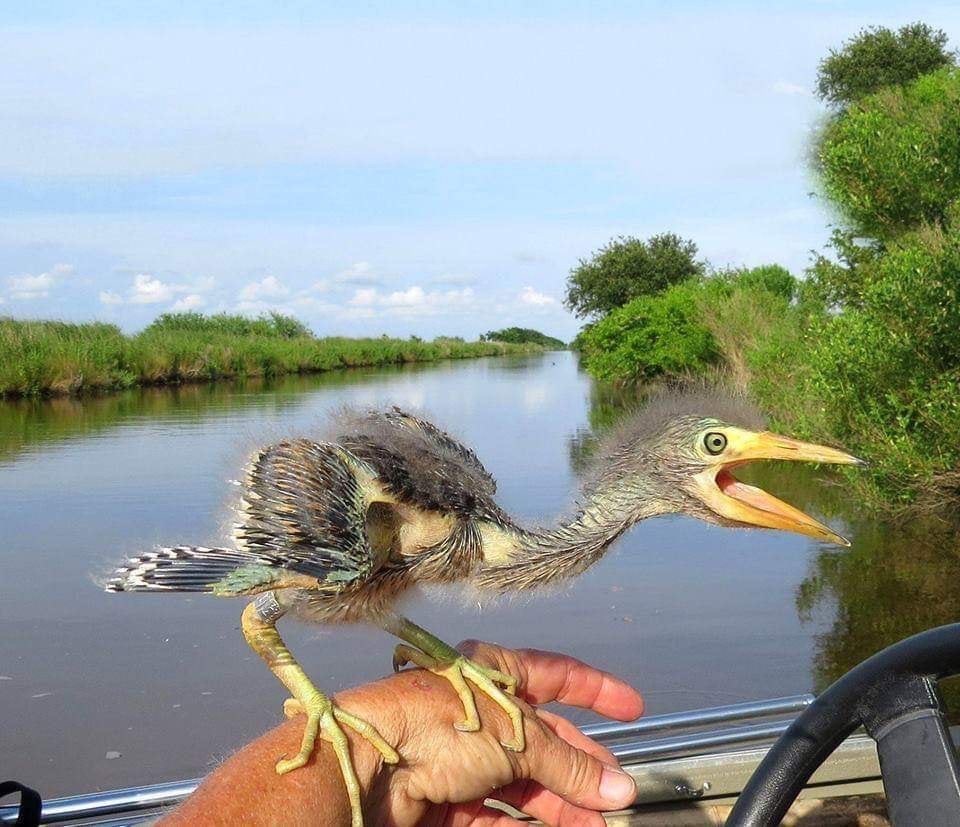
Pretty damn close. This baby green heron doesn’t have any teeth, which a dinosaur would have. And a heron’s wings are much, much stronger than any of its ancestors would have had in the dinosaur era. Feathers, too, have undergone sixty five million years of continuous evolution since the dinosaurs. But for us laypeople (layhumans?) it’s awfully difficult to look at this guy and see the differences between it and a dinosaur sixty-five or a hundred million years ago. It’s a good thing for Stephen Spielberg that Chinese paleontologists uncovered the mother lode of feathered dinosaurs in China after the Jurassic Park series had begun. Well, they’d already been digging them up, it just took a while for the realization to sink in with the public, who were having problems enough trying to accept that an asteroid had ended the Age of the Dinosaurs in a flash. Those were the days when if you knew that tyrannosauruses had feathers you kept it to yourself. You didn’t blurt that kind of thing out, and you certainly didn’t say in it front of the kids. You see that Tyrannosaurus rex chasing Laura Dern? The one that nearly chomped down Jeff Goldblum? It looked like a huge, psychotic chicken! The ushers would deposit your ass out on the curb before you could say Zhuchengtyrannusmagnus.
A baby green heron. Photo by JJJ Frank (from the Fascinating page on Twitter)
Not only were they huge, but it appears that this Titanes Ammonite pictured below was a free swimming predator, as it’s fossils are so often found in layers of marine sedimentary rock that shows no evidence of bottom life, that is, they were laid down in deep water. So like squid, which are also mollusks, they would have roamed the sea looking for eats. They would have also been fast moving, as the Jurassic seas were full of predators, and indeed many fossil ammonites have puncture marks that perfectly match the teeth of the jaw from mosasaurs, which were sort of like reptilian orcas. A mosasaur would probably have eaten you, or at least taken a chomp at your dangling supermodel legs (it’s always supermodel looking legs that get chomped in movies, never some dumpy looking dude’s), but hell, a mondo gnarly mega giant ammonite like the fucker pictured here might have taken a chomp of you too. Eats are eats. It was fast and rugged and mean in those Jurrasic oceans, so these ammonites were thickly shelled. There’d been an arms race between predator and prey since invertebrate predators were invented back in the very late pre-Cambrian (maybe 550 million years back) but all we got now of them are the fossilized shells, none of the soft bodied creature that lived in and protected by the shell. The predators developed stronger and stronger jaws as the prey developed stronger and stronger shells. These huge coiled ammonite shells must have been uniquely strong, dealing with a variety of giant swimming reptiles and sharks so vast and terrifying the SciFi channel is still making really cheesy scary megalodon movies today.
Alas, no ammonites survive today to tell us how their innards worked. One asteroid and poof, they’re gone, though some species did cling on to existence for an extra 200,000 years. That sounds like quite a stretch, after all recorded human history only goes back 5,000 years, but 200K is scarcely a blip in deep time, almost nothing at all, just long enough for the last of the ammonite species to fail to successfully reproduce in sufficient numbers to survive the new tough times. Sad, really. They originally developed sometime in the Devonian over 400,000,000 years ago, thrived through all earth’s ups and downs for over three hundred and thirty five million years only to have an asteroid just ruin everything. Sometimes shit happens and fucks up everything, to quote, um, well to quote nobody, as no one would be stupid enough to think up that line when trying to sum up such a vast and profound tragedy, so of course it’s the first thing I think of. No wonder I never finished college. But I am rendered wordless, at least of pretty and poetic words, trying to describe the empty feeling I get looking at this glorious empty shell of an Ammonite fossil. If only we knew more about them, what they ate, how they hunted, how they mated, what they looked like, even how they propelled themselves. It’s like finding the magnificent binding of a book with all the pages torn out, it’s beautiful but there’s no story inside. Imagine what it had contained, in life, all those hundreds of millions of years of evolution, all the stories, and not even a hint of what they contained. Their story now begins when it’s over with just the saddest postscript imaginable. PS: the earth runs into an asteroid, and the last ammonite fossils we can find are in beds of sediments laid down 200,000 years after the end of the Jurrasic world.
And dig that clever movie tie in. I‘m hoping for a check from Universal any day now.
From the Geology Wonders Facebook page (6/19/19) “Wow. Look at the size of this titan of an Titanites Ammonite! This was found by Andy Randell and team during a visit to southeastern British Columbia. Photo: Denver Coliseum Mineral, Fossil, Gem & Jewelry Show”
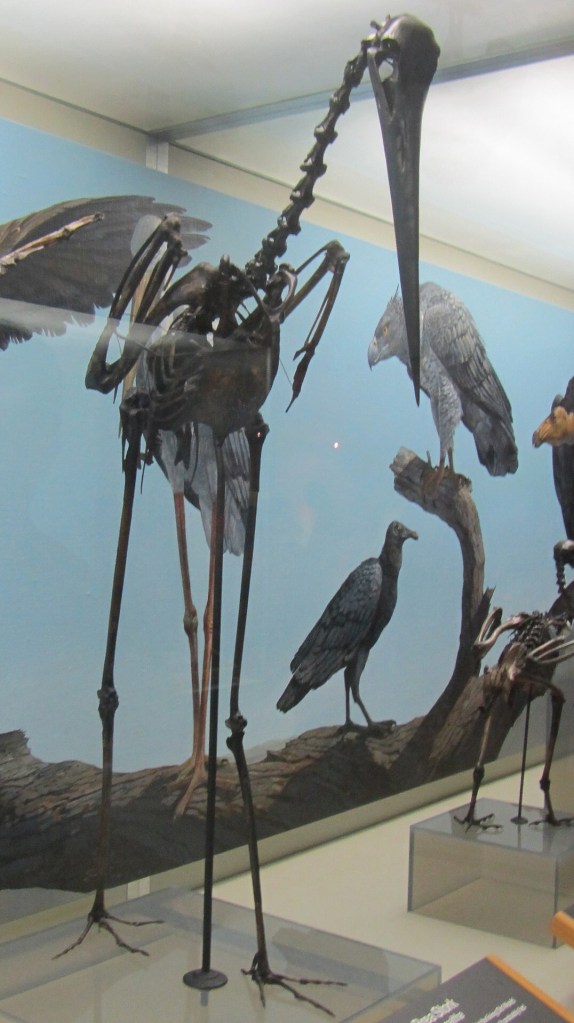
We’re so used to the La Brea Tar Pits in Los Angeles we don’t even realize just how incredibly cool and bizarre it is that such a place is right there on the Miracle Mile. One of my favorite places and museums. Saw a pigeon trapped in one of the little pools of tar there once. A thin veneer of water laid on top of the tar, and the pigeon had just walked on in as a pigeon will. It sat there, doomed, illustrating how the thing worked. That was at least twenty years ago, and it’s bones were long ago sucked down into the tar and eventually, in an instant of geologic time, will fossilize into a beautifully preserved skeleton of a pigeon. Still, I felt really sorry for the little thing.
Ciconia maltha from the La Brea Pits. Not a pigeon.
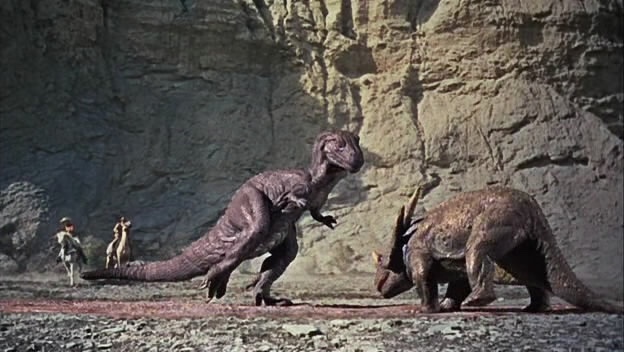
Any dinosaur obsessed school kid knew that in One Million Years B.C. Raquel Welch was chased by an allosaurus and not a tyrannosaurus, though by the time that kid was in high school the genus of the dinosaur mattered less than the topography the dinosaur was chasing. But allosauruses had bigger arms than those silly things dangling from the upper torso of Spielberg’s (and artist/designer Crash McCreery’s) tyrannosaurus, not that you’d notice if you were Jeff Goldblum. But had it truly been a Jurassic Park, it would’ve been an allosaurus ignoring Goldblum’s jokes. The allosaurus was the iconic apex predator of the Jurassic Age, the eater of the brontosaurus (OK, apatosaurus), going back easily 150 million years, whereas T Rex was the apex predator of the Cretaceous period, a mere 70 or 80 million years ago. As I watched the movie that occurred to me, but for once I shut up.
A Late Jurassic allosaurus (named Gwangi) beautifully rendered by Ray Harryhausen for The Valley ofGwangi (1969) battling an unnamed Cretaceous styracosaurus. Again with the paleontological discongruities. Also, cowboys.
A thirty plus ton meteorite dug up in Argentina. A larger one had been dug up nearby some time ago. The area is spattered with numerous other craters. Here’s the scary part—apparently both the two ginormous meteorites and the other craters were from the same meteor shower that freaked the locals out of their ever loving minds between 4200 and 4700 years ago, or in the parlance of the press, about the time of the Great Pyramids. (Everything is either older than or the same age as the Pyramids in the news.) Allow yourself a moment to consider the modern possibilities of such a meteor shower. Yes, one could hit Trump. But it could hit the San Fernando Valley too.
Just for comparison, they dug up an 66 ton meteorite in Namibia a century ago that smacked into the Kalahari 80,000 years ago. Again, a mind fuck for the locals, whoever they were then. One wonders, if it were seen, how they conceptualized it. How they discussed it. If they painted it on cave walls in ochre, as they seemed to have been doing not far off not long afterward. If they were even there at all.
But I digress.
The Namibian meteorite (since called the Hoba) is a rough square about nine by nine feet and three feet high. Halve that mass for each of the two Argentine. On the other hand, the megameterorite—an asteroid, perhaps a comet—that whomped into the Gulf of Mexico and zapped all the dinosaurs but birds into the cornfield was from seven to fifty miles in diameter. At that high end you could have wrapped the entire San Fernando Valley around it, with a little squeezing here and stretching there, like some weird Arthur C. Clarke novel, just as a thought experiment. Or you could forget you read that sentence. You could put that Hoba meteorite in my living room and still have room for the Christmas tree.
Considering the perfect math of objects orbiting the sun, some of the millions of asteroids in the solar system, some as big or bigger as the dinosaur whomper, are bound to touch, smack or whomp the earth again, many, many times.
Saw the 1995 Gamera reboot last night. Awesome. Scientific, intellectual, and they flatten Tokyo. He’s—wait, is he a he? There’s no huge swinging giant monster balls, but he does have a violent streak for a turtle—anyway, he fights this neo-Rodan whose name escapes me and they totally fuck up everything scientifically and intellectually. All that plus the usual paleontologists, doomed fishermen, panicky city folk and suicidal reporters. Lots of tanks and jets and rocket launchers, too, plus the occasional pathos. And if some of Gamera’s behavioral traits–bipedalism, fire breathing, spinning, flying, even the touching inter-species empathy–test the credulity of testudine phylogeny, it makes for some groovy giant monster action sequences. So while not exactly David Attenborough, it certainly stands as the Citizen Kane of giant turtle movies.
Today is National Poop Day, apparently, and here is my fossilized poop collection. It didn’t used to be a collection but a stoner asked me what it was and I said it’s a coprolite, and he said what’s that and I said fossilized feces and he dropped it. He apologized profusely but I said don’t worry it only cost me a buck and he laughed and sniffed his fingers and went to wash his hands.
I was told by the fossil poop dealer that it was probably from an amphibian and is probably from the Permian. Which means, if true, that whatever species laid down this shit probably went extinct with 90% of all species on Earth at the end of the Permian a little over a quarter billion years ago. Sad.
Brick Wahl losing it in the comments section of a British tabloid:
There is almost nothing correct in this article. Aegirocassis benmoulae was not a lobster. It was not even kind of like a lobster. Not even sorta kinda vaguely like a lobster. Indeed, there is virtually no connection whatsoever between Aegirocassis benmoulae and lobsters. Had you printed the actual artist’s rendering of Aegirocassis benmoulae your readers would have noticed, after tearing themselves away from Kim Kardashian’s ass, that the lobster comparison was a bit of a stretch. Indeed we human beings are more closely related to frogs, flamingos and lungfish than Aegirocassis benmoulae was to a lobster. Which makes me a six and half foot lungfish and you a hopefully soon to be extinct failure of a science editor.
Somebody had to say it, if David Attenborough won’t.
Alas, this comment was deleted by The Express. I knew I shouldn’t have said Kim Kardashian’s ass. Arse maybe.
Lobsters the size of HUMANS swam the seas 480 million years ago, new fossil reveals
A GIGANTIC lobster bigger than a human once populated the oceans, a new fossil find has revealed.





 Brick's Science