Earthquakes in the grand scheme of things

“Scientists Fear the BIG ONE is Coming as FOUR Major Earthquakes Strike in 48 Hours” exclaimed The Express in proper tabloid fashion. Japan is rocked by four quakes in two days, each over 6 on the Richter scale. Not a terrible quake, a 6.0 or so, but a rocker and scary enough. There were even a couple deaths. Japan handles temblors like this well. They are used to them. Of course seismologists worry that they might be foreshocks announcing a real monster of a quake, though Japan is used to those too.  Alas, there is nothing unusual at all about earthquake clusters like the four The Express is screaming about, especially in Japan, where four tectonic plates–the vast North American, Eurasian, and Pacific plates, and the smaller Philippine plate–grind against each other with slow violence. The northern half of Japan is mostly part of the North American plate, the Southern half is the Eurasian plate, and the Pacific plate is forcing itself beneath the Eurasian plate (a process called subduction) at a rate of about three and a half inches a year. Sometimes the subduction process gets stuck for a few years and then, after enough pressure builds up, it moves forward with a jolt. Sometimes it’s a little jolt. Sometimes it’s a 6 point jolt. And sometimes it’s a jolt so big everything shakes to pieces and the sea comes roaring back in a tsunami. That’s Japan. We have earthquakes in California as well, of course, but no one is subducting anybody. Rather our plates are slowly grinding past one another, so that the shaking, even at its worse, cannot get to the same level as Japan is prone to. In Alaska, though, where the Pacific plate is being subducted by the North American plate, you can have earthquakes of astonishing violence, like the one that leveled Anchorage in 1964.

The Express story hinted that the quakes in Japan could set off quakes in, say, California. As if somehow earthquakes were all interconnected. And while earthquakes on the same (or on linked) fault lines can be related theoretically, ones thousands of miles away can’t possibly be, because there would not be enough energy released from an initial quake to go through thousands of miles of solid rock from Japan to California. And the fact that there are four major quakes in 48 hours in a general region–say across East Asia–is just chance, as there are hundreds of quakes 6+ every year and sometimes a few of them happen within a couple day stretch.

Remember that earthquakes, in the grand tectonic plate scheme of things, are extremely minor events, just little quivers, nothing. While to us they can be terrifying, devastating, even catastrophic, in geologic terms they are just everyday things. After all, every great mountain range in the world is the result of literally millions of earthquakes. When you think how few large earthquakes you have lived through living in, say, Los Angeles, you get an idea of the time scale in building mountains, and how we can play no role at all in that process whatsoever. Nothing alive can. Mountains rise and erode as if life never existed at all. Because in the grand scheme of things life means next to nothing, really. Life is just a process for making coal or limestone.
Monotremes and you and me

Found this buried in among the drafts and I have no idea when it was…

It began as a post about a donkey in a hole. Farmer shovels in dirt, donkey takes a step up, farmer shovels in more dirt, donkey takes another step up. Finally the donkey is out of the hole and the hole isn’t even a hole, it’s full of dirt. The lady had thought maybe it was a real story–the picture of the donkey in the hole–and hated the farmer. Not sure why, but on Facebook you have to hate something. Me, I hate cat pictures. This lady hates farmers with donkeys in holes. I stopped paying attention. A day or two later I check in again, unintentionally. The thread had gone off topic, from donkeys to platypuses. Placental mammals to monotremes. The lady hated platypuses. Why do you hate platypuses, someone asked. They lay eggs, she said. Another guy said it’s because they’re monotremes, sort of a link between mammals and reptiles. The lady said eww….

Eww? Have you ever seen a platypus or an echidna, I asked. I mean, they’re adorable. Personally I love echidnas. I’ve never seen a real platypus…there aren’t any outside Australia, not even in zoos.  They have laws keeping them there. Echidnas, though, are in zoos all over the place. Some come from Australia, some from New Guinea, they look kinda like hedgehogs and trundle about looking for ants mostly and are cute as hell. The L.A. Zoo had a whole indoor display full of eucalyptus and koalas and echidnas. The koalas mostly slept, the echidnas trundled. I was being kind of Facebook obnoxious, I have to admit. But I was only beginning.

Because to be one of those really obnoxious Facebook people, I explained that a monotreme is actually a living example of one of the earliest stages of mammalian evolution, an early stage on the track which went from which from monotremes like echidnas and platypuses to marsupials like kangaroos and wallabies to placental mammals like you and me. And to be even more incredibly obnoxious, I explained that mammals didn’t evolve out of reptiles, synapsids did. The early synapsids are called  pelycosaurs, the most famous of which is the sail-backed dimetrodon.

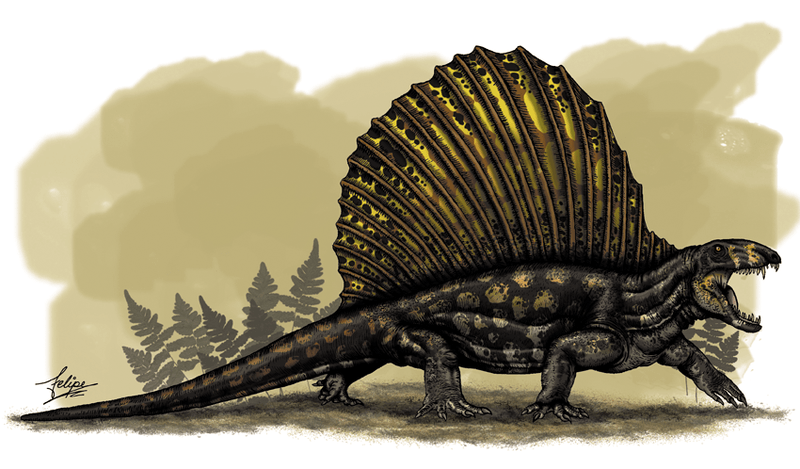
Dimetrodon, about 275 million years ago.

Every child’s  favorite pelycosaur, the Dimetrodon, about 275 million years ago.

Most synapsids were much less exotic looking, however. And one, sans sail, evolved into therapsids, aka the mammal-like reptiles, from whence we eventually came.

The weirdly cat-like Pristerognathus, about 260 million years ago.

The weirdly cat-like therapsid Pristerognathus, about 260 million years ago.

Alas, nearly all the pelycosaurs and therapsids died out in the Permian extinction event (which took out 90% of all know species on earth, actually). Just before that, though, in the late Permian, a line of therapsids had evolved into the way more mammal like cynodonts, some of which somehow survived the Permian extinction to continue in the Triassic, a world virtually bare of species and ripe for dramatic evolutionary change, especially among reptiles. Hence all those wacky dinosaurs. Cynodonts, in comparison, seem much more mundane and functional. No cynodonts became tyrannosaurs or apatosauruses. None ever rose out of our imaginations to level Tokyo.

But one line of cynodonts that had survived the extinction eventually evolved into early mammals sometime in the latter half of the Jurassic, little shrew looking things that hid in the shadows from dinosaurs and were predecessors of the echidna and platypus and in the long run, you and me. But it would take another extinction event, this time a massive meteorite or comet, to end reptile dominance and enable our skulking little shrew-like predecessors to evolve into a zillion species and fill niches world wide. Actually not all were shrewlike, some may even have been downright cute, for egg layers:

At eighteen inches long, castorocauda was more like a platypus than a shrew, 160 million years ago.

160 million years ago the castorocauda, at eighteen inches long, looking more like a platypus than a shrew

However, you and me, being primates, probably did evolve out of the sneaky little shrew like creatures skulking about in the dark. But we didn’t evolve directly out of reptiles. And we are not related to dinosaurs at all. What did evolve directly out of reptiles, of course, were birds, which actually are dinosaurs, the only surviving dinosaurs who then radiated globally into a zillion species in the global emptiness follow mass extinction. And just as chickens are dinosaurs, we humans all still synapsids, like the dimetrodon. In fact, synapsids are much older than dinosaurs, which means that birds are actually a later creation than are mammals. Way later. Hence we keep them in cages and dice them into McNuggets. And when you look at a raven and think that’s a dinosaur? It could be looking at you and thinking and that’s a synapsid? Except all it’s really thinking is that it wants your sandwich.

What does this have to do with a donkey in a hole, someone said.

Humans being are scared because being scared is human.

Terrorism in Western Europe Used to Be Much Worse read the headline in Mother Jones. Someone asked if terrorism is so much lower than it was forty years ago–see the chart below, the difference in scale is dramatic–then why is fear up so much?

Probably because there is nothing else to be afraid of. Human beings, having evolved under constant predatory pressures, are by nature very fearful. Back in the 70’s Americans were scared shitless of terrorism, but we were also worried about World War 3 and an incredibly high crime rate and some truly scary serial killers. Fear was a continuous presence, and there was much to be genuinely afraid of. Now there is a lot less to be afraid of, very little even. So we focus on terrorism. People will always be terrified of something.

Our very intelligence, the incredibly high level of human cognition, developed in response to our terror of predators. It probably even was one of the factors in the development of language. (Think of vervet monkeys, with their distinctive cries of danger for leopard, snake, eagle.) We can’t live without fear. People who are naturally without fear literally have something wrong with them…. and those eastern techniques people use to attain inner peace–that is, freedom from fear–require extraordinarily intense concentration and practice to overcome our intrinsic fear.

Homo sapiens are the only surviving human species out of dozens, and it is assumed that nearly all the other species were driven to extinction by predatory pressures. Life in the plains was extremely dangerous. We remain the sole survivor because our ancestors were the only one who developed technology to help us fight back, and did so an incredibly long time ago. Homo habilis had developed tools way over two million years ago, which means they must have already been using stones as missiles, much like baboons do. Our survival strategy was probably much the same as baboons–groups that defended aggressively against predators, except that baboons can live in very large groups because they are primarily plant eaters, and we were forced to live in smaller groups because we ate mostly meat. That made us much more vulnerable to predators–especially leopards (in fact, leopards still kill scores of people annually). Therefore we had to have a much more acute wariness about leopards (which are ambush hunters), which helped us survive where every one of our competitors failed. Being scared all the time was not only a survival strategy, it made us human.

Incidentally, of the four surviving genuses of hominids, three–orangs, gorillas and chimps/bonobos–all live in dense forest, which protects them from predators. We are the only genus that survived in open country, from H. habilis through H. erectus to H. sapien. And we did that by be incredibly wary. Even now, living in completely artificial homes surrounded by all this technology and never eating anything we killed or harvested ourselves, we will always find something to be freaked out by. Fearing sudden attack by terrorists is not that different from fearing an ambush by a leopard.

Leopards, in fact, may have evolved as hominid eaters, as both they and we evolved as species at the same time. As prey we may have actually been a prime driver in their evolution. You look at a leopard and you might be seeing a cat designed to kill you, specifically. There is no other predator designed to eat us. Leopards certainly are much more adept at hunting us than are lions or cheetahs. Leopards even have human-specific methods of killing us, preferring to catch people indoors while they sleep. They haunt Mumbai by night, taking a dozen or so of us in a bad year within the city limits. They are epicures of humans as food, oenophiles, sometimes killing one of us with quick bites to the neck, then tearing open the throat just to lap up the blood that pools on the floor. They drink their fill and slip out the way they came in, unseen, leaving the meat uneaten.

After writing that, I walked over to make sure the door was locked. There are killers and terrorists everywhere.

4093_people_killed_by_terrorist_attacks_in_western_europe_since_1970_n

Two giant tiny civilizations trying to conquer the world beneath our feet.

Nazi ants? I’d never heard that one before. But a friend said it, referring to the long columns raiding her kitchen night after night. Effing Nazi ants, she said. The tiny insects has gone from being household pests to threats to civilization itself. Civilization? Well, my personal civilization, she said, her clothes and cats and knick knacks and foodstuffs. There’d been a blitzkrieg just that morning, an effing Nazi ant column seizing the high ground around the cat food dish. She really didn’t like ants.

I mentioned that, coincidentally, there are certain ant species that are informally classified by myrmecologists as fascist, world domineering species. The catchline is that if those species had nuclear weapons the world would have been blown up long ago. Luckily, I added, ants are tiny and somewhat technologically incompetent.

You’re scaring me, she said.

Buy a can of Raid, I said.

It’s funny, when I was a kid ants were stubborn, pesky rubber tree movers. Whoops there goes another rubber tree plant sang Sinatra in a song he probably did not sing too often if he could avoid it. Antz and A Bug’s Life were late reflections of that sort of ant. Cute ants. Hard working ants. Ants, tiny little things that together seemed worthy of anthropomorphism. The first books on ants I read were like that. Of course, there were also the Nazi/Mongol/Evil Empire army ants who ate people in the Naked Jungle. But army ants lived in jungles, far away. Everything was scary in jungles. In America ants rhymed with rubber tree plants. Cute.

Then myrmecology became popular, mainly because of E.O. Wilson. That huge book he and Bert Hölldobler did back in the 1990’s, cleverly titled The Ants, actually became a best seller. It’s a door stopper and quite technical, but had lots of great photos and several hundred thousand Americans bought it. Go figure. It was followed by a whole series of books on the romantic lives of myrmecologists and on ants themselves. I’ve probably read all of them. I have a miniature myrmecology library. As people became more myrmecological, the trend in the perception of ants moved from Sinatra to fascist. Ant societies became these incredible superorganisms (in fact, Superorganism by Bert Hölldobler is sitting in my to be read stack) that would be absolutely terrifying if they weren’t so damn small. Perhaps the fire ant invasion and the killer bee invasion suddenly made social insects into scary things. But Argentine ants are kind of unsettling too. You probably remember when you were a kid in California that there were several different kind of ants in your yard. I remember little black ones, littler black ones, big red ones, little red ones, and medium sized black and red ones. I remember seeing some of these in Hollywood and Silver Lake back in the 80’s still. They are all gone now. Only Argentine ants remain. In brutal tiny wars we never saw they annihilated every other ant species they came across in California’s urban and suburban areas. Only the big red ants survive, but they exist in areas away from people and a regular water supply. Argentine ants like water. Hence they might be in your sink right now. (We just had a swarm of them on the fish tank.) Fire ants, incidentally, the only ant in the United States that can actually kill people (given enough stings and anaphylaxis), need even more water than Argentine ants, so large parts of southern California are out of bounds for them. Not suburban lawns, though. We water those. Perfect for both species. And somewhere out there in Orange County right now a war to the death is going on between fire ants and Argentine ants. The Argentine ants, here, are winning. They’ve lost in Texas and the deep south where there is sufficient rain. But the limited fire ant invasion in southern California thus far is due mostly to a combination of our dry climate and our annoying Argentine ants. Curse them in your kitchen, spray them, stomp them, sprinkle them with Borax, but be glad they are outside on the sidewalk, in the garden, in the lawn. Otherwise you’d have fire ants everywhere in southern California. Argentine ants are our deliverance, like Stalinist Russia destroying the Third Reich. Two giant tiny civilizations trying to conquer the world beneath our feet.

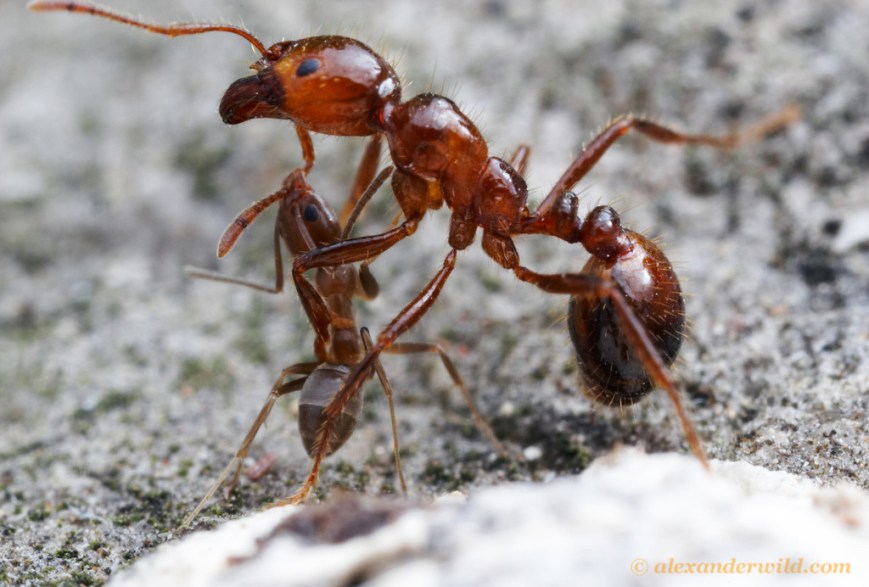
argentine ant vs fire ant

“An Argentine ant (Linepithema humile) attacks a much larger fire ant (Solenopsis invicta).” From an absolutely gorgeous photo essay at http://www.alexanderwild.com. Highly recommended site, some of the finest nature photography I have ever seen.

Say it with slaughter

So Genghis Khan has 35 million male descendants. Not bad for a little guy with stupefying body odor.

It also gives an idea just how many conquered males the Mongols would slaughter, and how they took control of a land and its people by propagating their genes which meant propagating their power structure. Something similar happened in Mexico after the conquest–the Mexican national genome has markers from indigenous females and male Spaniards, with far more varied female markers present than male, meaning that Mexico was repopulated after its sixteenth century population crash (population reduced by up to 90% from its 1491 level) by a small population of Spanish males who kept themselves quite busy. Denying the conquered males the chance to propagate is something right out of the great ape playbook, and indeed goes back further, with so many mammals and birds and even fish following the same strategy. As for body odor, Genghis–and indeed the whole rank Mongol army who you smelled, they say, before you ever saw them–would have been potent androstadienone cocktails. Hubba hubba. It’s all about romance. Say it with slaughter.

Wombats

A video gone viral of a lady scrubbing a wombat.

Adorable. I imagine wombats are a little light on the smarts, though. Apparently in the early days of mammalian evolution mammals got by on cutes alone. The world was full of birds, a few big and deadly, sure, but most not, and the genuinely dangerous dinosaurs were all long gone, and the surviving reptiles never much of a threat. So you could be cute and roly poly and it worked in some odd evolutionary way. It was a step up on the monotremes, at least, who were just weird. Spikey, duck billed, egg laying, poison toed. Pretty ladies do not hold spiny echidnas in their laps and scrub them, at least not twice. Nowadays, though, anywhere outside of Australia you have to be a lean mean killing machine ball of kitten fluffiness to be considered cute. Placental mammals play rough. Slaughtering birds by the billions and melting people’s hearts. Imagine that, how humans were preyed on by leopards for our entire existence–there are million year old hominid fossil bones that million year old leopards had scraped the meat from–and now we think that little tiny scale models of leopards are the cutest things ever. Disturbing. Doubtless the distant end to humanity can be found in hardwired psychology like that. Wombats, though, are from a dumber time, when human genes were still trapped in annoying little prosimian genomes, while off in placenta-free Australia marsupial wombats were all dumb as little dorks, lolling in the sun and never getting jokes, but laughing anyway.

wombat

One wet wombat.


Earthquake

(2014)

southern california faultzones

3-dimensional view of major Southern California faults. Vertical faults like the San Andreas are pencil thin lines, those at an angle to the surface are broad brush strokes. (Taken from the highly recommended site earthquakecountry.org.)

That Puente Hills fault that caused the quake out in Brea yesterday (in 2014) is the one that terrifies geologists. They used to think the Elysian Park fault was the killer–our house sits right atop that one–but it now appears to be dormant. But in the last ten thousand years the Puente Hills fault has snapped in a huge way four times, and each of those quakes was a 7 plus on the Richter scale. That would be ten times at least as powerful as the 1994 Northridge quake. Furthermore, the Northridge fault directed its energy away from downtown (with explains how places as far away as Fillmore were leveled) but the Puente Hills fault would direct its energy towards downtown. I suppose that is how people in downtown last night felt the shaking of a quake centered in Brea so strongly (and why we scarcely noticed while we were out in Tujunga). The Puente Hills fault stretches from roughly Brea to Beverly Hills, and it has three active areas–Brea, Whittier (remember the Whittier Narrows quake in 1987?) and here. And I mean right here…downtown Los Angeles is square in the middle of it, and the zone’s width goes from just below USC to about where I am in Silver Lake. In fact, being that I am typing this while literally astride the Elysian Park fault, our place is just outside the Puente Hills fault zone, not that we wouldn’t shake like hell anyway. We wouldn’t shake as bad as people on the nearby flatlands, their homes built as they are on layers of sediments, but we’ll be shook up something awful. I dread the thought of it. It won’t be boring, anyway. (There was another shaker on the Puente Hills Fault in January 2015 that got everyone’s attention just a few blocks from us but that we literally did not feel at all. Not even the cat noticed.)

The Puente Hills fault is a thrust fault. Everyone knows how the San Andreas fault (which cuts through the Antelope Valley down into the Coachella Valley fairly distant from us) is between two plates that slide past one another. Every once in a while the plates get stuck and then snap apart. The movement is horizontal. West of the fault goes north, east goes south. But a thrust fault is vertical movement, that is the fault zone is thrust upward. As the tectonic plates move, pressures build up in the rock beneath us. Stress fractures appear, which we call faults. Those pressures reach a point where something has to give and when they do, you get an earthquake along one of those stress fractures. Most of the times these quakes are imperceptible to anything but a seismograph machine. Sometimes they are strong enough to wake the cat. Sometimes they are strong enough to set off a flurry of chatter on Facebook. And sometimes they are bigger than that. In a really big quake along the Puente Hills fault zone, the ground will suddenly lurch up a meter or two, meaning that the part of town from USC up through downtown will be instantly elevated above the area south of it. Think of it this way: all the north south streets–Alameda, Hope, Flower, Figueroa, Hoover, Vermont, etc.–would suddenly be unusable, because at some point past Exposition Boulevard there would be a three or even six foot drop straight down. Not gradual, not sloping, but straight down. You will need a ladder to proceed down the sidewalk. That is what huge quakes on thrust faults do.

No one knows when this will happen. It will happen. There is no way it will not happen. But it could be before I finish this post, or it could be in a couple thousand years. Every city on the West Coast from Anchorage (trashed in 1964) to San Diego (my first earthquake memory) faces the prospect of a disastrous earthquake. That is the geologic reality of living on the Pacific Rim. It’s scary as hell if you think about it much, so I don’t think about it much. We try to be a little prepared, though. Just in case. Ya never know.

I wasn’t going to post this. Like maybe it’s too creepy. But maybe people should know. A lot of you do already. But it’s amazing how many residents of this area have no idea what might happen if we roll seismic snake eyes.

Now I need a drink.

And you will too, after seeing this Visualization of a Puente Hills Earthquake. It is in real time, and the color key represents the degree of shaking. Blue is the least violent, green more so, yellow even more and on into the red. You notice that the more intense shaking–the greener, yellower and even red colors, are in the flatlands between downtown and the Palos Verdes Peninsula. The sediments of the basin there are up to six miles deep, laid down mostly when the land was ocean bottom and compressed into the easily crumbled rock that you see in some roadcuts. But the meandering Los Angeles River has over thousands and thousands of years left deep, sandy soils that once made for terrific farmland and now are really prone to intense liquefaction when the ground shakes. There was intense damage in this area after the Northridge quake, probably all of which was caused by liquefaction. The ground under overpasses on the Santa Monica Freeway lost its solidity and the poor things just toppled. That’s an impressive sight, and immense concrete bridge in pieces on the ground. That was the destructive power of liquefaction. And that epicenter was much further away than this hypothetical Puente Hills quake would be. The damage from a 7 magnitude quake in the Downtown area would be exponentially greater. A lot more overpasses would topple. A lot of houses will be red tagged. What a mess.

Probably be some great yard sales, though.

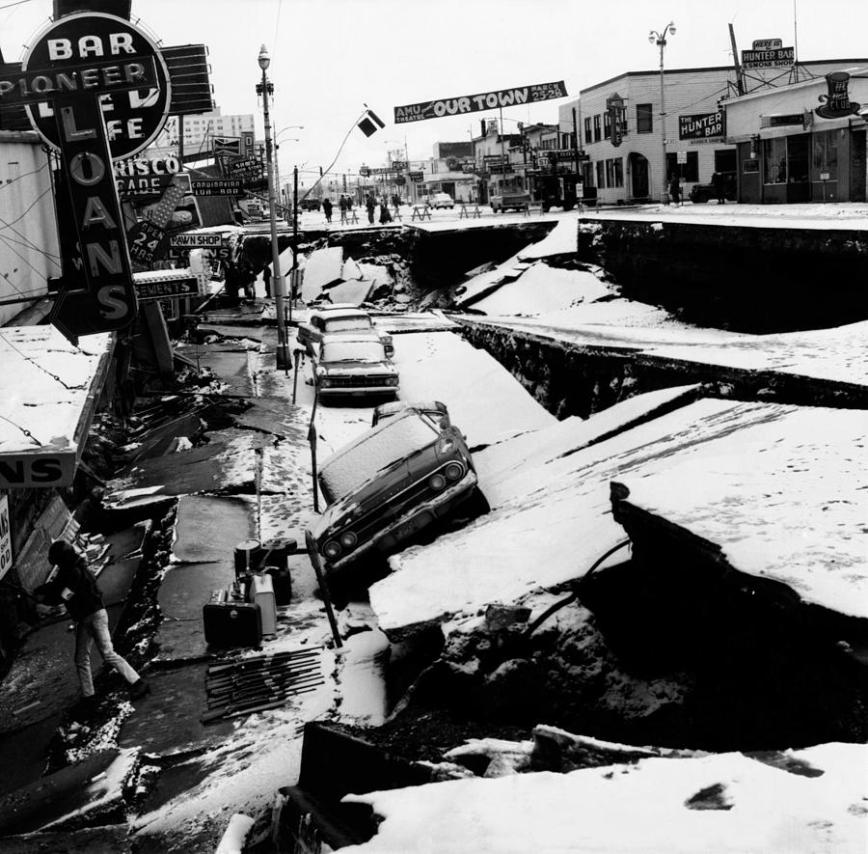
1964-alaska-earthquake-anchorage-everett

Anchorage, 1964. You’ll be happy to know that no matter how nasty a quake the San Andreas has in store for Southern California, this sort of thing will not happen. The Anchorage quake was one vast tectonic plate (the Pacific) suddenly shoving itself beneath another (the North American plate). Subduction they call it, a slow process that every once in a while gets stuck. When subduction unsticks you get scenes like this. The North American plate side of 4th Street here wound up 38 feet above the Pacific plate side, making parking difficult. This cannot happen on the San Andreas, which is where the same two plates just slide past each other, one heading north, once south. Occasionally things get stuck and then, after some time, unstuck. It was the unstuck that leveled San Francisco in 1906. And it will be a similar unsticking that will someday level Palmdale and Palm Springs, shaking the rest of us something awful. However, there would be no displacement like that in Anchorage–the San Andreas unsticking would be a sudden horizontal movement, not vertical. If that makes you feel any better.

Eusocial insects

“Great point about insects. Spooky levels of selflessness.”

Not all insects. Social insects. Or eusocial insects, in the parlance of the trade. I am not sure if there has been altruism observed among other insects, but among social insects a selfless sort of altruism, to the point of suicide, makes perfect sense because  reproduction is typically done via parthenogenesis. That is, reproduction is asexual, so the offspring–the workers–are genetically identical with the queen, and thus a worker’s exact genes are passed on–via reproduction with males–when new queens leave the colony. The various castes in a colony are developed heterochronistically, where hox genes change the rate of development. You can see that in the various sizes of ants boiling out of a nest. Big ones with huge mandibles are soldiers, most workers are medium sized, while smaller ants and even tiny ants all have their roles in the colony. Everyone has the same genes, but alterations in the growth rates within those genes time their development. Just like in human beings. Heterochrony even assigns us our roles at times. Hypermorphosis creates big tall guys who become professional basketball players. Neoteny creates jockeys. But where male hypermorphosis among us is driven in large part by sexual selection, that is not a factor in ant parthenogenesis. Everyone in an ant colony is genetically identical, and almost none of them will ever have sex anyway. That is left to the queens and males. The rest are just there for the gig, workers mostly, some soldiers. There is actually a lot more variation in individual ant behavior than we might assume–some ants just hang around inside the colony, doing as little as possible–but their roles are decided for them. A worker can no more be a soldier than a basketball player can be a jockey. Yet its that immutable caste system that gives the ants their staying power. Their colonies are not machines, not computer programs, but are what E.O. Wilson calls super-organisms, a whole bunch of tiny little organisms that together act nearly as one. Taken to its furthest extent, the power of an ant colony can be extraordinary.  

The Argentine ant supercolony, the ants that drive Californians nuts with their endless invasions, stretches along the California coast, the southeastern coast of Australia and along vast stretches of the western Mediterranean. It is estimated to number billions of individuals, as as many ants as there are human beings–except that every single ant within it, from San Diego to Sidney to Marseilles, is genetically identical. Obviously we human beings are not. Our very development as a species was dependent on the fact that we are not identical. It’s hard to imagine how homo sapiens could ever have survived without genetic variation. Disease itself would have annihilated us. But a single colony of genetically identical Argentine ants seems to be taking over the world…or the parts within climate zones it can survive, and it has increased its population to as many individual ants as there are people and it is genetically identical. Somehow, it works for them. That is the beauty of the eusocial ant business model. Then again, it seems inevitable that something will eventually exploit that lack of genetic variation throughout the entire Argentine mega colony and tear into its impregnability the way the Roman Empire was gutted by Goths, Vandals, Persians and plague in its Crisis of the Third Century. And if this could happen before the Argentine Ant Empire permanently conquers the kitchen in our own household version of the Crisis of the Third Century, I wouldn’t mind.

2-novelattract

Argentine ants, working.

When octopuses rule the earth

The octopus is an alien, an utterly confused tabloid piece read. One of those English papers. It quoted a scientist. One never jokes like that to a tabloid. Of course, the piece ran riot across Facebook. It may have been old news about the octopus’ nervous system, a week or two old anyway, but no one had mentioned the alien quote. It must be an alien, a marine biologist said. Friends of mine posted this in all earnestness. A zillion objections ran through my head–DNA was one, why would an alien share so much DNA with sea slugs and clams and snails–but what really stuck out for me was an octopus’s life span. If it’s some sort of advanced alien they sure don’t live very long.

Most octopus live from six months to two years, though a few species live up to five years. That’s it. They reach the end of that span and the body ages to the point of death. I’d always thought that the tragedy of the octopus is that it’s life span is so short there’s no way for individuals to either acquire decades of knowledge or pass on a culture. Mating is usually the cause of death, indeed of the process of death itself, the males die within months, the females not long after the young hatch. Oddly enough, females do because they stop eating while protecting the brood, they’ve done experiments that led the females to resume eating right after egg laying which led to much longer life spans. Had there been a mutation that allowed a species to do what was done in the lab then imagine the difference…. Unfortunately, no such mutation occurred, or remained, apparently starving oneself to protect the brood has evolutionary advantages. (Nor has there been found a way to stop the male from aging suddenly after fertilizing.) So advanced invertebrate intelligence has been held back by invertebrate reproduction. Which always strikes me as incredibly sad.

Still…the octopus has been around for a quarter billion years, and mammals didn’t even exist a quarter billion years ago (we were still non-mammalian cynodonts, the mammal-like reptiles that fully mammalian cynodonts–that is, mammals–evolved from maybe 25 million years later). Life in the sea is far less dynamic and less dangerous than life on land. Species can survive vastly longer before extinction, and their environment changes much more gradually. Even today’s climate crisis won’t threaten the existence of octopus species in the long run–after all, they emerged about the time of the Permian Extinction and glided through the end of the Cretaceous, when the planet was smacked by a giant meteor and rent by massive vulcanism at the same time. So octopus species–there are about three hundred known now–are quite likely to be on the planet for a long, long time.

And all it might take in that long, long time is a genetic mutation that, say, delays the onset of reproduction by a few years, long enough for octopus culture to increase in complexity and be learned by other observant octopuses, and then that more complex culture giving enough of an evolutionary advantage so that the mutation would not die out competing with octopus who reproduce at the current age. It was Homo habilis, a couple million years ago, who first began human culture in proto-human form, making tools from rocks by methods that would have required careful watching to master. Doesn’t this happen among some octopus species now? This would certainly have to be learned. The beginnings of culture are there already, and Amphioctopus marginatus and some similar species from around the Pacific is at the same stage with their coconut halves that Homo habilis was 2.8 million years ago shaping rocks into hand axes. Apparently one local population of Amphioctopus marginatus (or a related Amphioctopus species) figured out the body armor thing (perhaps using bivalves shells rather than coconut shells) just as a family or cave full of Homo habilis conceived the shaping of stones.

But while Homo habilis could live twenty, even forty years, Amphioctopus marginatus live from six months to a year. Imagine that–octopus have created and passed on tool using methods (by observing and copying) in a life span that, for any homo species, would scarcely go beyond infancy. But there is nothing saying that a mutation that enabled a longer octopus life span can’t happen and survive long enough to create a new long lived octopus species. It doesn’t seem like it would be an impossibility. Indeed among cephalopods the nautilus lives twenty years or more (not that far from that of homo habilis), and doesn’t even reach sexual maturity until fifteen, or three times longer than the longest octopus life span. Nor does a nautilus die after a single reproduction. However, the nautilus is more similar to the cephalopods of five hundred million year old than to octopus (and squid and cuttlefish.) Either at some point the nautilus developed iteroparity (multiple reproductive cycles) and a longer lifespan, or octopuses (and squid) switched to semelparity (a single fatal reproductive cycle.) Either way, it seems that the chain of mutations to increase the octopus life span should be theoretically possible within the genome of the octopus. (Mutations do not materialize out of nothing, but have to be possible within the genes and possible growth rates already within the parents’ genome. You can see that range in sexually dimorphic human beings, a man six and a half foot tall flirting with a woman four feet ten.) So there’s nothing saying that a quarter billion years from now (as I said, evolution is a vastly slower process in the ocean than on land, where it took a mere thirty five million years to go from monkey to human being) a long lived species of octopus will not be the smartest thing ever on earth. Some of them are using tools already, and I know some humans that can’t even do that.

Octopus habilis.