DNA testing

So apparently if you get one of those DNA tests, they send you a chart that shows you all the percentages of what ethnicities you are. Then you get to pick out the one that is coolest and be that, as if only that little slice of your genetic heritage made you what you are. But sadly, your Cherokee great great great grandmother didn’t leave you the least bit Cherokee other than a smidgen of Cherokee genes, or your Zulu great great grandfather or the one Irish great grandmother left you neither Zulu nor Irish. Think about it like math–an eighth (your great grandparent) or a sixteenth (your great grandparent) or a 32nd (your great great great grandparent) is just a tiny little bit of you, and the other seven eighths and fifteen sixteenths and 31/32nds long ago washed out most of that inheritance. You are what you are, which is whatever most of you is, all mixed up together, blended, and poured anew into what became you after hopefully a terrific simultaneous orgasm. Your Cherokee great great great grandmother would never even recognize you as one of her own, nor would you take in anyone who said he has 1/32nd of your own genetic background. After all, there are probably hundreds just like him out there, all equally related to that same woman who was born maybe two centuries ago. Which kind of takes the shine off of those DNA tests. It’s just DNA. But it doesn’t mean you have any actually viable connection to any of your distant ancestors other than sharing some of the same genes. And many (if not most or all) of those genes would have mutated during some of those successful couplings between you and your great great great grandmother anyway, so they aren’t even all the same genes. Go back far enough, in fact, and provided you do not come from a carefully maintained line of strict inbreeding (sisters marrying brothers) there will likely not be a single genetic behavioral trait–that is, something that makes your personality distinctly you–remaining that you share directly from your very distant ancestor. The genes behind those traits have all been replaced during successful couplings since then. The raw material of genetics are there, and have always been there, since life began, but the actual genes last only so long. None of us share any of the exact same genes from critters millions of years ago that we have descended from (the synapsids, or mammal like reptiles, for instance), and none of us are passing on specific genetic traits from even several hundred years ago. Maybe your great great great grandfather from Ireland was a writer. And maybe you’re a writer. Did you inherit writing from him? Nope. Lots of people are writers. It just so happens that two people out of the 32 people in the line from your great great great grandparent to you happen to be writers. And two out of thirty-two is almost surely nothing more than coincidence. You might look like him…but then you might look like people you are not directly descended from. After all, that great great great grandfather is only one out of 32 grandparents having sex 16 specific times that gives you the DNA that, all mixed together and randomly mutated, is you. You are much more likely a writer because you had a good English teacher than because one of those 32 great great great grandparents also wrote. Culture trumps genetics in most human endeavors.

Stick with reincarnation. That gets around the whole genetics thing, saves you money on DNA testing, and maybe you slept with Shirley MacLaine in Ancient Egypt. She was a queen. You a slave boy with gumption. Torrid passions two hundred generations ago in the shadows of the pyramids. I mean why not? Though that might make you 1/1280 of yourself in a past life.

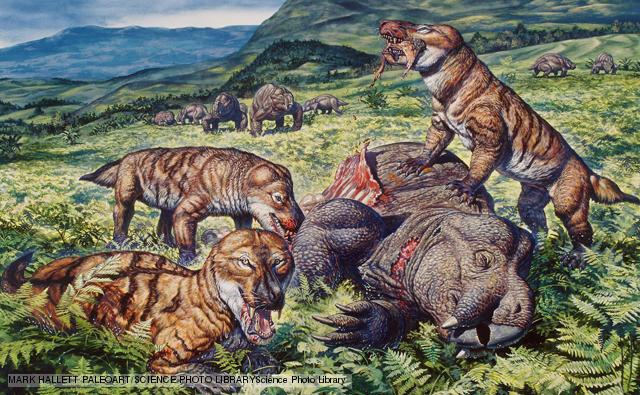
Mammal-Like Reptiles

None of my Synapsid ancestors were writers.


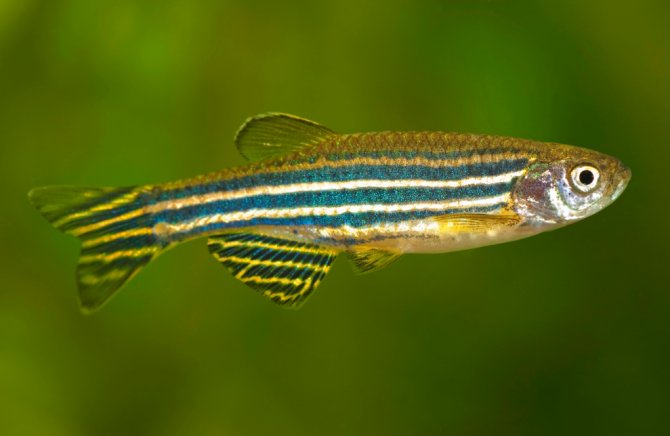
I’m not sure when exactly the zebra danios turned into killers.

Our zebra danios have gotten scary. Where once they’d dash about madly at the top of the tank waiting for the flakes of food, now they wake slowly from sleep, huddled together, then in a three fish column begin moving slowly (not their usual frantic dash) into the plants, moving around them, seeking meat. The flakes of fish food float down all around them but they pay no attention. They keep prowling, methodically, maybe an inch or two from the bottom of the tank. I’ve come to suspect that this was how they killed the other fish, by catching them before they were completely awake there amid the plants. I can only imagine that all three would rush in, striking, chomping, killing. In the wild they eat insects and crustaceans and worms, so they are hunters, yet in the thirty some years we’ve been stocking our aquariums with them I have never witnessed them do anything more than grab flakes of fish food drifting by. I have certainly never seen this sort of apparently coordinated behavior. It seems that almost every vertebrate has within it the predatory behavior. We are all hunters. Hell, it was predation that drove evolution itself, the whole Cambrian Explosion with all its crazy speciation was the result of the ever evolving contest between predator and prey. And here, somehow, in our little aquarium, something turned these little inch and half long fish from eaters of fish food to eaters of fish, eaters of even their own kind (as there were five of them just two weeks ago). All was peaceful until the clown loach died. That loach, though never deliberately bothering any of the other fish, was at seven inches long to them like a whale shark is to us. It ruled the floor, digging up snails. The danios stayed up several inches in the tank, away from its sudden movements. But then the loach, one day two or three weeks ago, was dead. Old age. I noticed the next morning that the danios were down zipping around at the bottom of the tank. The neon tetras calmly minded their own business, the two glass catfish scooted about. Everyone, danios included, got very excited at feeding time, like they always did. Everyone swam around excitedly, grabbing bits of tetra min flakes floating by.

I’m not sure when exactly the danios turned into killers. Within two weeks I realized that all the fish were gone but these three zebra danios. Alone in the tank, they chased each other madly about, zipping one way, then another. I was mystified. Where had all the other fish gone? I did some research, and found desperate pleas on aquarium websites. “Help, my zebra danios are eating each other!!!!” or “My zebra danios are killing my other fish!!!” I read in shock just how murderous the little beasts can be. No one seemed to know why, but there was usually a dominant fish that sets it off. A handy bit of evolution, that, where some members of the species will suddenly go rogue, turn alpha, and eat everything piscene in sight. Obviously there is a genetic advantage in there somehow. Perhaps a surge in zebra danio testosterone. But I have no idea. Looking at the tank again, one of the danios is swimming like a lunatic now, frenzied. The other two have ducked behind the leaves. Perhaps there is murder afoot.

zebra-danio2

It doesn’t look like a killer.

Dinosaurs

But dinosaurs didn’t die out. The finch peeping incessantly outside the window right now is a real live annoying little fuck of a dinosaur and is not extinct. Nor was the chicken you ate last night. Well, that particular chicken is extinct, but not the entirety of chickenness. However, non-avian dinosaurs died out–duck billed whatevers and spiky triceratops and clunky ankylosaurs and vast and bulbous titanosaurs. They all went poof instantly or not long after the meteor hit and volcanos belched. As did soaring pterosaurs and swimming mosasaurs and paddling plesiosaurs. Even polyglyphanodonts went extinct at the end of the cretaceous. True, they were only lizards, maybe three feet long and not the least bit scary, but I only posted this so I could say polyglyphanodont. Polyglyphanodont. Polyglyphanodont. Polyglyphanodont. Too much fun.

A shark goes for a walk

Nice bit of convergent evolution on display here when you compare this shark with the fish that evolved into all us four-limbed landlubbing tetrapods. Our own fish ancestors, though, were lobed finned with bone skeletons (like coelacanths, or an even better example, lungfish). Mudskippers, a walking ray-finned fish, are another bony fish though unlike either early tetrapods or this epaulette shark, it uses only its pectoral fins and not the pectoral and pelvic fins. Mudskippers pull themselves around by their front limbs. Tetrapods and epaulette sharks walk. Or proto-walk. They use all four limbs. Watching this little epaulette shark is eerily like watching a monitor lizard. It’s hard to think of anything strictly terrestrial that moves like a mudskipper. Yet it is conjectured that most early tetrapods like Tiktaalik lived much like mudskippers, and not much like this epaulette shark. Go further back a few million years into tetrapod evolutionary history and you can find lobed fish, such as Panderichthys, that probably lived lives much like our walking shark. Unlike mudskippers and we tetrapods, however, sharks are famously boneless. They leave lousy fossils, mostly teeth. Some really terrifying teeth, too. Megalodon has left its thirteen inch incisors scattered in fossil beds world wide.

But this shark here is maybe three feet long and quite harmless, and I watch and rewatch him perambulating across the Coral Sea floor cartilaginously, a nifty trick, but severely limiting if one is thinking about evolving into a land animal. Without the buoyancy of water, one needs the support of a bony skeleton. Gravity is a bitch. But one also needs a bony skeleton to evolve fins into limbs that all of us tetrapods use for legs, arms, feet, hands, fingers, toes, and wings (and sometimes back into fins). The jointedness of bones seems to open up a wide range of mutation possibilities–and evolution is all about mutations–that cartilage just does not seem to have. Sharks and us have been on dramatically divergent evolutionary paths since we last shared a common ancestor well over four hundred million years ago. And shark evolution, though impressive enough in its sleekness, is vastly less varied than that of those of us who spring from the homelier lobed finned fishes (and less varied than the bony ray-finned fishes, which make up well over 99% of all fish species but never left the water). Aside from our perambulating friend here, all sharks (and their cousins, the rays) swim, while nearly all of the tetrapods (i.e., four limbed creatures who live on land) walk. But the same mutational capacity that enabled the first tetrapods’ pectoral and pelvic fins to evolve into a dizzying variety of limbs continues to enable tetrapods to evolve amazing adaptations with their limbs. Vertebrate flight has evolved three times (pterosaurs, birds, bats) while frogs and kangaroos hop and snakes and legless lizards slither limblessly. There are lizards and a number of mammals who glide. Pangolins go totally post-tetrapodal and curl up into an armored ball and hurl themselves down hillsides (the sort of thing that does not show up in cladistics.) A few tetrapods have even gone back to the ocean for good to swim again, the front limbs evolving again to pectoral fins, the backs legs disappearing entirely, as if four hundred million years of terrestrial evolution had all been some terrible mistake.

Yet the simple advantages of walking along rather than swimming over a shallow sea bottom (watch the video at about 25 seconds when the shark stops to peer into a cavity, looking or smelling for possible prey) apparently led this shark along a trail of mutation that eventually allows the thing to walk with ease. And it is extremely unusual for a shark. The range of design among sharks and rays is very minimal. Very few sharks don’t look very similar to other sharks. Rays look like rays. A Greenland shark is notorious for being so old and creepy and strange looking. But it looks very similar to almost all other sharks. An aquarium with nothing but sharks would be a pretty dull looking aquarium. They look a lot alike, they act a lot alike. Then we see a video of a epaulette shark walking along the ocean floor like it’s the most natural thing in the world.

A prowler of tidal zones, an epaulette shark can survive for hours in extremely low oxygen pools. It cannot breathe air, though, as mudskippers and lungfish do and our own water’s edge ancestors once did. Rather this shark has evolved a way to reduce blood flow in critical periods to all but the brain and heart. Handy, but a no go as a terrestrial adaptation. One needs to breathe air to make it on land. So this remarkable shark is no more like us than we are like it. It’s a marine animal who sometimes can stay on the edge of land for a couple hours, just as we are terrestrial animals who sometimes can swim with the fish for short periods.

But it was the combination of using fins to lift and carry across surfaces (i.e., walking) where swimming was difficult or impossible, with getting oxygen from the air via lungs (i.e., breathing) instead of taking oxygen from the water via gills, that made vertebrate land animals possible. (Insects were already there–doubtless tetrapods were eating them–but they had evolved from marine invertebrates, and our last common ancestor was somewhere deep in the Pre-Cambrian). There are over 30,000 species of tetrapods today–7,500 amphibian, 10,000 reptile, 10,000 bird and over 5,500 mammal species–and all remarkably seem to have come from one species of lobed finned fish that managed to combine both fin walking and air breathing, and had an unusual capacity for mutation in pectoral and pelvic fins. There was a wide range of these mutated fins at first–as many as eight digits on each fin–before the final five toes/fingers was arrived at. (Perhaps the occasional six toed kitten or baby are a mutational echo of that.) There seem to have been many species that could do so and apparently the lush and swampy Devonian shore line was rich enough in food and varied enough in niches a half billion years ago to allow evolution to run riot. But apparently only one of those species led to all the four footed or two footed and two armed or winged creatures breathing air today, including us. And while this beautiful little epaulette shark has nothing to do with any of our own evolution since the Devonian, as it is only very distantly related to any of us tetrapods, watching it trundle across the ocean floor does give a brief glimpse of what our own origins looked like nearly half a billion years ago.

Liberal arts

(2014)

I  said it before and I’ll say it again…liberal arts college education has left us with two going on three generations of very literate college grads who are completely ignorant of science. It’s ridiculous. The stuff you hear coming out of smart people’s mouths. You wonder if they ever had a science class at all. You want proof? Look at your Facebook page. If they believe in chemtrails they’ll believe anything. If somebody began a Facebook meme that gravity is a hoax people would believe it.  And the only reason a lot of progressives profess a belief in evolution is that so many Republicans don’t. It’s ideology. They haven’t a clue how natural selection actually works. Every time someone starts going on about the Darwin Awards I roll my eyes. People simply don’t get it.

Ignorance is bliss, I guess. But if someone had ever told me that the Internet would actually result in a population more scientifically ignorant than before, I would never have believed it. But that is what has happened. When it comes to science it’s a liberal arts wasteland out there.

Can your car be hacked?

(2010)

Here’s something you probably never thought you’d have to worry about, (courtesy the Norton Cybercrime News which pops up on the screen here monthly and magically and a tad creepily even). Can Your Car Be Hacked? it asks, in a big bold font. Oh yeah baby:

Vehicle disablement — After a disgruntled former employee took over a Web-based vehicle-immobilization system at an Austin, Texas, car sales center, more than 100 drivers found their vehicles had been disabled or their horns were honking out of control.

Tire pressure system hacking — Researchers from the University of South Carolina and Rutgers University were able to hack into tire pressure monitoring systems. Using readily available equipment and free software, the researchers triggered warning lights and remotely tracked a vehicle through its unique monitoring system.

Disabling brakes — Researchers at the University of Washington and University of San Diego created a program that would hack into onboard computers to disable brakes and stop the engine. The researchers connected to onboard computers through ports for the cars’ diagnostic system.

Wow. More fear, icy fingered, merciless, terrifying, annoying. It just keeps piling on. Must be the recession. There are fears everywhere, some big, some little, some a disgruntled employee making my horn blare in the middle of the night or a tire pressure monitor going nuts or my brakes failing on Baxter St., plummeting me down onto the Glendale Freeway at the speed of light.

Ya know, I get the OnStar Diagnostic Report which pops up monthly and magically and a tad Star Treky which tells me what condition my car is in, including the aforesaid brakes and tire pressure (and maybe even the horn, hell I don’t know.)  I can also press a button on my rear view mirror in the middle of nowhere a thousand miles from home and some dude in OnStar World Headquarters can tell me why this or that light came on and if I am doomed or merely inconvenienced or even not to worry at all. That’s very Star Trek too. OnStar also lets me call people and yell at them over traffic noise, it helps get the schedules of two-car ferries that cross the Mississippi from the middle of nowhere Illinois to the middle of even more nowhere Missouri, and there’s a button to press when you are dying and a guy will tell you not to die.  It’s pretty cool. Cars are full of Star Trekness anymore. Or maybe Forbidden Planet, and the dudes at OnStar are the Krel, knowing and doing all for $18.95 a month, except without the Walter Pigeon voice (or Ann Francis legs.). But it never occurred to me that they could take control of my car. The whole monster of the id thing, but it’s Manny, Moe and Jack’s id. Who knows what their evil plan is. I don’t want an air freshener in my car. Especially the pina colada one. I found one hanging from my rear view after a car wash. I get in and there it is dangling, reeking to high heaven of the worst pina colada ever. There are probably bars in Ensenada that smell just like that. I did the Repo Man thing and chucked it out the window before peeling out of there. But it was too late. That cheap tropical smell took weeks to fade away. It was a piece of shit car though. I used to fill the trunk with a beaten up drum kit and play loud abrasive music in the unseemliest dives ever. Those were the days. I smell pina colada and I think of my youth. Back then no one hacked into your car except to swipe the battery. No one was stealing AM radios anymore.

And here I am, decades later, and it’s Good Friday morning and I’m wondering if some evil twerp will make my horn blare between noon and three. Or sunder my brakes on a steep street. Or just mess with my car somehow.  And I’m telling myself not to worry about it. It’ll never happen. Bad things never do to good people. Which is a lie of course and doesn’t help me at all. This didn’t happen in my parents’ 1967 Oldsmobile Vista Cruiser, I tell you. We controlled our own destiny then. We were masters of our own flat tire.

4/2/2010

Cat up a tree

Neighbor’s cat stuck up in our back yard tree for the third day now. So far all attempts at rescue have failed. All it has to do is climb down six more feet and it can be rescued. So of course, being an idiot cat, it climbs up another ten or twenty or thirty feet. From there it could also go another six feet and leap onto the roof. Nope. No one ever said cats were smart. Cute, OK, but not smart. Natural selection in house cats eliminated that sort of thinking in favor of snookumsness a long time ago. Hell, the dumb things can’t even conjugate a simple verb intelligently. I can haz cheeseburger, sheesh. And so there we are, three days of standing around the trunk of the tree and looking up as the stupid if adorable little beast looks down and cries at us like it’s our fault. Perhaps it is our fault. We domesticated them. Leopards don’t get stuck in trees. Then again leopards eat people. It’s important to keep things in perspective.

Tonite we will wind up picnicking around the tree, eating pork loin, mashed potatoes, corn on the cob and drinking wine, just to torment the little dope into coming down for a morsel. Not that it will work. Instead we will probably be attacked by raccoons. They, at least, are smart. And annoying. If cats were smart they’d be just as annoying, and we’d never have domesticated them. Problem solved.

Incidentally, here is a margay. A margay can climb down a tree, headfirst. Obviously we domesticated the wrong species. Of course, margays are from South America, and we are from Africa. One of us was on the wrong continent. Hence, there is a descendant of an African sand cat–native to deserts and Sahel, treeless all–stuck far up in the branches in our backyard, meowing its little sand cat heart out.

Cats–a forgotten draft

(an early draft of Cats, 2012)

Mockingbirds are strafing one of the neighborhood cats. A whole little mockingbird community, who spend all night and days shrieking at each other (at 3 a.m. it was a battle of car alarms) have banded together to dive on the hapless cat, who is frantically looking for cover. The birds are all fired up, having just driven off a pair of nest robbing ravens. So much violence.

I find it hard to feel sorry for Fluffy. Fluffy (not his real name) is a friendly cat, yes. Cute even, on occasion. None of the people around here have any issues with him. But mockingbirds have damn good reasons for taunting him. Cats love stalking and pouncing on birds. People deny that their cat does — kitty would never kill a bird — but pet cats let outdoors have wiped out a lot of urban bird populations. They can’t help it. It’s what they do, cats. They’re hunters. And so are coyotes, and all those pet cats people let outdoors provide a steady diet for coyotes. I suspect we wouldn’t even have populations of urban coyotes if it weren’t for all the house cats people let outdoors. The more cats people have, the more cats there are outside, the more coyotes can survive living among people. You could probably graph the rise in the popularity of cats as pets with the increase in the urban coyote population. You could, but you’d have a hard time getting laid afterward.

We used to have a local population of feral cats. Some big mean toms. They’d fight all night, those eerie, annoying cries of their’s waking everybody up just in time for the burst of intense violence that followed. Sometimes you’d hear cat bodies being thrown against the side of the house with some serious force. Amazing how much energy a cat can expend in a fight. Not for very long. Cats are anatomically sprinters, not long distance runners, like dogs. All their energy has to be in astonishing bursts, since the oxygen in a cat’s blood is quickly depleted. Hence their contests are more build up than action, and size almost always wins. So the biggest, meanest cats ruled our neighborhood. Nearly all of them were feral. The pet cats would skitter home beat up and bleeding. It was getting to be a problem. Cats making a helluva racket all night. People yelling at the cats. No one getting much sleep.

Then a pack of coyotes moved into the neighborhood. End of problem. The endless war cries of cats were replaced by the occasional high pitched yelps of excited coyotes. You’d hear them running down the street on the hunt. It’s weird, a quiet neighborhood and the yelping of wild canines. Like all this civilization wasn’t even here. Like it has been stripped away for a moment and you could hear what it was once like. It’s so spooky it’s thrilling.

The coyotes ate all the stray cats. And they ate a lot of pet cats, foolishly let out by their owners. They ate a lot of little dogs, too, right in their back yards. Sad little flyers appeared on telephone poles. Rewards were offered. There’s one right outside now. I can see it from my window. The little dog is just darling. The reward is one thousand dollars. There’s a lot of money in Silver Lake.

I like cats. And I dig coyotes. And birds. Ours are indoor cats only, so off the menu, and birds are off theirs. They watch the birds from the window. My wife feeds birds. Sparrows, finches, a couple kinds of doves. Every once in a while a scrub jay drops in and scares off all the other birds. Not as often as before, though. It’s been a while since I’ve seen a lesser goldfinch, a hooded oriole, or a towhee. A long time. There were more bird species in Silver Lake when we moved here in the 80’s. Especially here near the river. The explosion in the pet cat population coincided with the disappearance of several species. Birds like the towhee which spend a lot of their time on the ground were just too easy for cats. There are far more cats now than there were twenty years ago. Everyone has a cat or three. Crazy cat ladies don’t seem so crazy anymore, merely eccentric. People leave food out everyday to feed the strays to feed the coyotes. Funny how coyotes might increase the bird population. I used to think they might. Haven’t noticed it, though. [I do now, in 2016. Even the towhees are back.] For every cat eaten there must be two more cats being brought into people’s homes. People are just mad about cats.

There are several theories about just why. The weirdest one is that cats have passed on a parasite that has altered our behavior and makes us pay lavish attention to our pet cats. Parasites can do that, nature is full of examples. The theory got lots of attention, a big story in The Atlantic, and the scientist behind it was all over television. The science is a little sketchy, though. Let’s just leave it now and agree that people are nuts about cats. And cats are nuts about killing birds.

Cats are natural killing machines, remarkable animals, though we don’t really notice. The design hasn’t changed much since it’s inception around 30 million years ago. That cat, the proailurus,or dawn cat, looks remarkably like your cat.
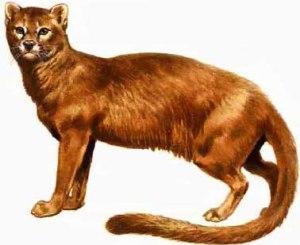
Proailurus

It was even about the size of your cat. Amazing how little things have changed in thirty million years. The head seems a bit larger now, which might be to make room for a larger brain. The proailurus’ jaws seem extended a bit, too, more dog-like, and the evolutionary transition to a modern cat jaw probably accounts for the larger head of the modern cat. The one pictured above has decidedly more weasel like proportions…or less kitten like. The tail of today’s house cat is maybe two thirds as long. Perhaps because modern cats use their tails to communicate and a longer tail could not be held straight up as easily. A tail straight up implies fear, for instance, and held aloft with the top few inches at a 90 degree angle shows friendliness. That larger jaw of modern cats also helps with communication, I’d guess. Small sounds resonate more inside a larger mouth, vastly increasing the cats vocabulary. House cats have an extraordinary range of sounds they make to each other. Some they make to us. Some they make for each other. They’ll call to each other and you’ll try to get their attention and they completely ignore you. Some kind of intense cat to cat thing going on, and we’re not supposed to know, like when two people break into a language you don’t know with you standing right there. When they want to talk to you they’ll let you know.

Felines have been compared to sharks as being perfect predators. Perfect hunting machines. And like sharks, once the initial design was laid out there wasn’t much alteration needed afterward. Of course sharks go back over 400 million years, but evolution in the open ocean, where conditions change vary little over enormous stretches of time, can proceed much more slowly than on land. The environment on solid ground is much more volatile. Species are under constant pressure to change or go extinct. Think of how humans have altered in just a few million years. Indeed, look at how much size variation there is even with our own species (writes the six foot five inch man). Not cats, though. All the small cats, from the cute, vicious little sand cat to the largest of the small cats, the cougar (which purrs just like the domestic short hair in your lap) come from proailurus, and all look very similar. Today’s big cats–lions, tigers, panthers, leopards, cheetahs–all descend from pseudaelurus, which itself descended from proailurus.  Weird to think about, he says, a housecat staring at him as he types.

The action outside my window has abated, for now. The mockingbirds are back up on their branches, quiet, looking for threats. Fluffy is up on the neighbor’s porch, glowering. And as the sun sets a siren wails and the coyotes come to life.

Narcan

The great thing about naloxone (aka Narcan) is that it saves lives. It really is a miracle drug. You can overdose on heroin and the paramedic can administer it quickly and you are good as new. Which is what is so great about naloxone, if the shit you just scored is too strong and you OD then the paramedics can bring you back to life. And if the shit is too strong but you don’t OD, then it’s just a better high. So why not go for the bigger hit? Come on, live a little, especially as you won’t die a little. You probably won’t die at all. Naloxone just makes being a junkie more fun and far less dangerous. Overdose deaths have plummeted, even as overdoses skyrocket. That is no accident. There are more overdoses now because the odds of dying of an overdose have fallen by several orders of magnitude. I can’t see overdoses dropping anytime soon, either, not with all that naloxone around. Just the opposite, the number will keep rising. Why? Because medical science has removed natural selection from the process. There are no more Darwin Awards for junkies. Everyone lives, everyone gets high, and only the very unlucky die. Like maybe the ambulance gets a flat tire. Shit happens. But how often does an ambulance get a flat tire? We have made heroin addiction a much more viable lifestyle, though a more expensive lifestyle, wanting higher and higher highs. Much higher than ever before. Those pictures of parents OD’d in front of their children? Parents used to worry about ODing in front of their children. Not anymore. A few drops of naloxone (aka Narcan) in the nose and mommy and daddy are good as new, though in jail, and the kids have been taken away. Oops. But still, naloxone means anyone can be a junkie now. Who can? We can! Narcan. Ask your druggist.

narcan